

Manufacturing Systems Engineered for Plant-Level Visibility
Manufacturing businesses slow down when production status, inventory, quality records, maintenance, and reporting are split across disconnected tools. We engineer the operating layer that connects daily plant activity with the systems your leadership already depends on.
Trusted by Operations-Led Teams








Where Manufacturing Teams Face Workflow Breakdowns
The pressure shows up in the gaps between teams, tools, and decisions where updates arrive late, ownership is unclear, and manual follow-up becomes part of daily operations.

-

Supervisors chase production status across shifts, lines, and work orders
-

Quality holds, inspections, rework, and approvals lack an auditable flow
-

Inventory and procurement updates arrive after production decisions are made
-

Automation efforts stall because process ownership and data structure are unclear
-

Maintenance records do not translate into downtime patterns or planning signals
-

ERP, MES, QMS, and finance data have to be manually reconciled before leadership can trust the numbers
Custom Manufacturing Software Built Around Daily Operations
Manufacturing software that doesn’t account for how your plant actually operates creates more overhead. We build around the real flow – how orders move, assets run, and materials are tracked and connect the systems around that flow.
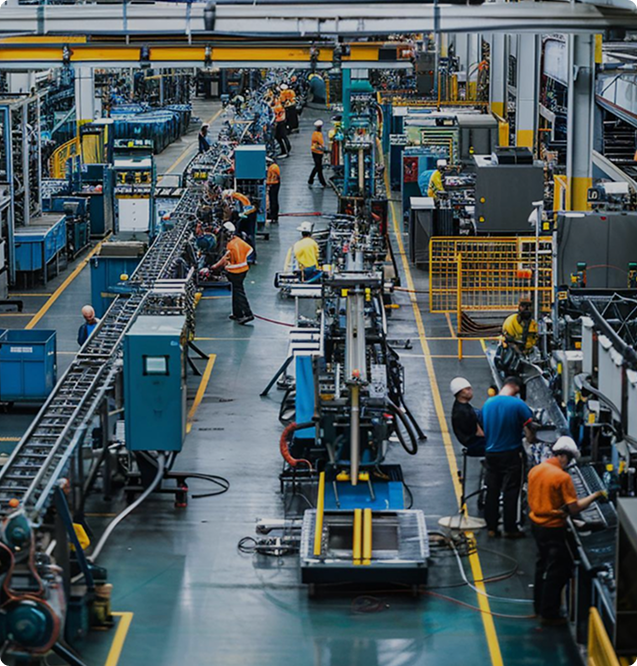
Systems for work orders, production status, shift activity, operator inputs, downtime capture, and live operational tracking.
What Changes When Plant Operations Connect
Clearer Shop-Floor Status
Production status, work orders, downtime, and shift updates become easier to track without constant manual follow-up.
Stronger Quality and Traceability
Inspection records, defect handling, and audit data move through workflows with clearer ownership and better visibility.
Reliable Operational Reporting
Production, inventory, quality, maintenance, and order data can support decision-making without the need for repeated spreadsheet reconciliation.
Your Core Platforms are Fine. The Connections Between Them are Not.
BOSC improves how information, approvals, exceptions, status updates, and operating data move across the platforms your teams already use.
Manufacturing Sectors We Work In
A semiconductor line, a component manufacturer, a steel plant, and an equipment business do not need the same software scope. We start with the production model, system landscape, and data flow before defining the workflow layer.
Semiconductor and Electronics
For traceability, inspection checkpoints, equipment data, yield reporting, and controlled handoffs between production, quality, and engineering teams.
Automotive and Component Manufacturing
For work-order status, supplier coordination, quality documentation, claims, delivery visibility, and production reporting across connected systems
Steel, Metals, and Industrial Materials
For batch or lot tracking, process visibility, maintenance reporting, dispatch coordination, and plant-level performance views.
Machinery and Equipment
For configure-to-order workflows, documentation, service requests, dealer or customer portals, spare parts visibility, and field feedback loops.
Why Choose Us
6+
years in engineering and system delivery
90+
AI-skilled product engineers
50+
systems modernized
30+
clients with 3+ years retention
AI Use Cases in Manufacturing Workflows
BOSC applies AI only where it can reduce review effort, surface exceptions, or improve access to operational knowledge without adding risk.
Defect Review and Visual Inspection Support
AI-assisted workflows for identifying, reviewing, classifying, or routing quality issues where image or video data is part of inspection.
Maintenance and Technical Knowledge Support
AI assistants that help teams search SOPs, equipment manuals, service histories, issue logs, and maintenance documentation.
Production Reporting and Exception Summaries
AI-supported reporting workflows that help summarize production status, exceptions, downtime patterns, and operational notes.
Inventory and Exception Triage
Workflow support for identifying stock issues, delayed orders, supplier exceptions, and production dependencies that need attention.
Document and Compliance Search
Knowledge systems for searching internal documents, process records, quality procedures, and technical references with clearer retrieval paths.
How We Work With Manufacturing Teams
We work inside real manufacturing operations where systems are already in use, teams are under pressure, and reliability matters more than experimentation.
Study the Live Production Flow
We review how production, quality, inventory, maintenance, reporting, and approvals move across people, tools, and handoffs.
Locate the Highest-Cost Workflow Gap
We first focus on the workflow, data dependency, or reporting gap that is causing the greatest delay, rework, or operational risk.
Stabilize Source Records and Integrations
We clean up data movement, system connections, validation rules, and reporting paths before adding automation or AI.
Build Around Daily Manufacturing Use
The platform, portal, dashboard, or internal tool is shaped around how operators, supervisors, managers, and leadership actually work.
Stay Accountable After Launch
BOSC supports the system beyond delivery, improving edge cases, monitoring reliability, and retaining ownership as operations change.
Success Stories Shaped by a Structured Approach



Want to Know More
How do manufacturers improve operations without disrupting live production?
Start with the workflow creating the most friction, such as quality holds, production status, downtime reporting, and improve it without touching core systems. Protect what is already running. Build the integration layer around what exists before considering any replacement.
What needs to be ready before AI is added to manufacturing operations?
AI needs clean operational data, defined review paths, cybersecurity controls, and workflow ownership. Without that, it becomes another pilot instead of a production capability.
Can legacy manufacturing systems still support better reporting and automation?
Yes. Stable data paths, validation rules, connectors, and workflow layers can modernize operations without forcing immediate replacement of every existing platform.
How should manufacturers approach IT and OT system integration?
Integration should be staged carefully, with clear data boundaries, access control, monitoring, and security review before plant systems are connected to wider business workflows.
What is the right first project for a mid-market manufacturer?
Choose the workflow with the most issues, such as quality holds, downtime reporting, production status, inventory exceptions, supplier coordination, or recurring reporting cleanup.
Will AI replace manufacturing teams or support them?
AI should support teams by surfacing exceptions, improving knowledge access, and reducing review effort. Human judgment remains central in production, quality, and maintenance decisions.
How can manufacturers reduce dependency on informal knowledge?
Capture SOPs, maintenance history, quality decisions, issue logs, and process notes into searchable systems so critical knowledge does not stay locked with individuals.