


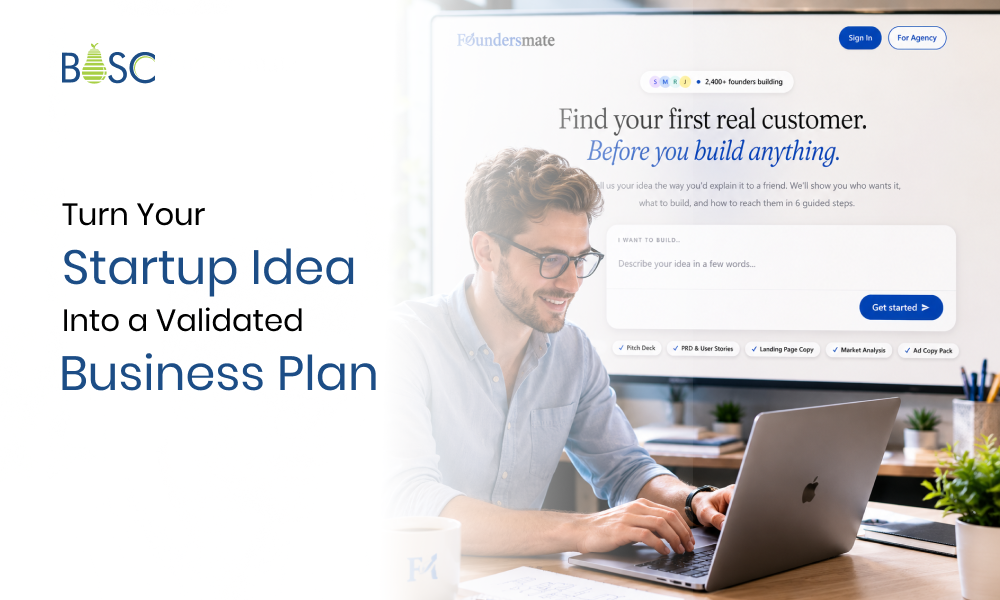
Most startup ideas begin with conviction. A founder sees a problem, imagines a product, and believes there is a market for it. But belief is not validation. The real challenge is finding out whether the right customers actually feel the problem, understand the offer, and show enough interest before significant time and money are invested in building.
That early gap is where many founders lose time and money. They either start building too soon, rely on disconnected AI prompts, or pay for strategy work before they know whether the idea has enough demand. In each case, the problem is the same: the idea moves forward without enough clarity around the customer, market, product scope, and first users.
Foundersmate is built for this stage. It helps founders turn a rough business idea into the practical assets needed to validate and plan it effectively, including customer research, a clear landing page, market strategy, an MVP, a pitch deck, and business planning documents.
This blog breaks down what Foundersmate is, how it works, what each feature creates, and why its structured workflow matters for founders who want to make better decisions before committing serious time and budget.
What is Foundersmate
Foundersmate is an AI-powered startup validation and planning platform built for early-stage founders, solopreneurs, and non-technical entrepreneurs who want to turn rough business ideas into concrete startup plans. The platform allows users to describe their startup idea in plain language and then converts that input into the key strategic assets needed to move forward.
This includes customer profiles, market insights, MVP scope, product requirements, landing page copy, pitch material, and go-to-market direction. Instead of spending weeks manually researching, structuring, and documenting an idea from scratch, businesses can use Foundersmate to create a more organized starting point for validation, planning, and execution.
Differentiating factors of Foundersmate:
- It’s a business-analysis agent, not a generic chatbot, working through a structured workflow where every output, like research, requirements, copy, and deck, stays intact.
- It’s built for people who can picture their product clearly but can’t translate that vision into market research, a requirements document, or an investor pitch.
- Foundersmate gives you assets, not opinions. It generates the deliverables a founder would normally pay specialists to create.
- Foundersmate builds a connection in the prompts. All outputs, from research to product scope and pitch material, are generated from the same idea, keeping everything aligned.
What it Costs to Move an Unproven Idea Forward
A founder with a new idea has three ways to move it forward, and each one costs something before the idea is ever proven.
The first is to build it now. Development, design, and tooling add up quickly. It’s realistic to spend ~$20,000 turning an idea into a working product. Plenty of founders only discover after launch that the customers they pictured aren’t there, meaning the money was only spent on guesswork.
The second is to work it out with a generic AI or LLM tool. The answers are less correct and disconnected. You get a customer profile in one chat, a feature list in another, and ad copy in a third, and none of them reference the others. A few hours of prompting leaves you with fragments, not a plan, and the job of stitching them together falls back on you.
The third is to hire an agency. Proper discovery and strategy exist as a service, but they cost ~$4,500 or more and take weeks, which is hard to justify for an idea you haven’t yet confirmed.
Foundersmate is built to fill the gap all three leave behind:
- You shouldn’t have to spend money to learn whether the idea is worth money. Foundersmate puts customer research and demand testing first, so the build decision follows the evidence rather than precedes it.
- A clear idea isn’t a clear brief. A founder can describe a product clearly in conversation but may still struggle to turn it into a PRD (Product Requirements Document), an MVP roadmap, or an investor-ready deck.
- Structure shouldn’t carry an agency price tag. The same documentation that an agency would charge thousands for is generated straight from your description, with no retainer and no multi-week wait.
Foundersmate sits between these options with a $79 one-time startup kit. You spend less on discovery before the idea is proven, or on hours trying to connect scattered AI responses. You get a clear validation set, planning, pitch, and product documents from one guided workflow.
That price point is central to the platform’s value. It gives founders a practical way to organize and test an idea before committing to development, agency strategy, or a larger product budget.
Key Features of Foundersmate
Foundersmate maps the three stages of the founder journey. That includes understanding the market, attracting users, scoping the build, plus a few kit-level documents that tie it all together.
- Know Your Market
Confirm who actually wants this and why, before you build anything.
ICP Report
Identifies your ideal customer segment and the specific problem they face, so you can target a defined buyer rather than guessing at “everyone.”
ICP Interview Guide
Provides the exact questions to ask real prospects, turning your customer assumption into something you can validate in an actual conversation.
Competitor Snapshot
Maps the competitive landscape, including platforms that already solve this problem and where you can realistically win or lose against them.
- Get Your First Users
Test with real people to see if they want this before you commit to a full build.
Live Landing Page
A publishable page you can deploy immediately to put your idea in front of real visitors and collect genuine interest.
Ad Copy Pack
Pre-written messaging tailored to your ICP, so the traffic you drive to the landing page actually matches the customer you’re trying to reach.
GTM Strategy
A concrete plan for where and how to reach your first users, replacing vague “we’ll market it later” thinking with actionable channels and timing.
- Build the Right Thing
Scope the product around a customer and demand you’ve already confirmed.
Value Proposition
The proof that makes your target customer immediately recognize the product is built for them.
MVP Scope
Defines which ships in version one and which get cut, keeping the first build lean and focused.
Pitch Deck (PPT)
An investor-ready presentation structured to present, not assembled from scattered notes.
Business Plan
Integrates the customer, product, and market findings into one coherent narrative.
PRD & User Stories
Developer-ready requirements that spell out each feature and its acceptance criteria, eliminating ambiguity in the build.
Market Analysis
The wider market context that explains why this customer segment matters and the size of the opportunity.
How Foundersmate Works
The founder explains the idea naturally in Foundersmate, and the platform turns that input into a guided startup planning flow. Instead of treating the first prompt as the final brief, Foundersmate asks intelligent follow-up questions based on the idea, so the final outputs are built on clearer context rather than a one-line assumption.
Once that context is clear, the platform moves the idea through three deliberate stages that reflect how most founders and business owners should approach early planning. The customer is confirmed first, demand is tested next, and the final step is product scoping. Each stage feeds the next, so by the time you know what to build, that decision rests on the previous two stages.
Is Your Idea Safe With Foundersmate?
For founders, the idea itself is sensitive. A startup concept may include product strategy, customer insights, technical requirements, market positioning, and early business plans. That makes ownership and privacy an important part of any tool used at this stage.
Foundersmate users retain full ownership of the content they enter and the outputs generated through the platform. It also does not sell project data or use it to train public AI models. The founder owns the business concept while the platform only structures it.
The platform also highlights security practices such as HTTPS, secure cloud infrastructure, access control, logical data isolation, and controlled data handling with AI providers.
Before You Build, Know What You’re Building with Foundersmate
Foundersmate does not claim to validate your idea. Real validation still happens with real customers. What it does give you is the complete toolkit to prepare for that validation: a defined customer, market direction, landing page, MVP scope, product requirements, pitch material, and business plan.
That kind of startup planning usually takes weeks to pull together through manual research, generic AI prompts, or agency discovery. Foundersmate offers a one-time startup kit that is more affordable for validating a product vision before spending serious money on development.
For early-stage founders, that structure matters. You keep ownership of your idea and outputs while getting a clearer way to test assumptions, explain the product, and decide what to build first. The real value of Foundersmate is not that it replaces founder judgment, but that it helps founders make better decisions before they commit to the digital product development.