

Most AI agents your teams interact with can respond. A few can finish the task. That gap is where backlogs build, escalations happen late, and the cost of each unresolved task compounds. The shift from conversational AI to action-capable agents is already underway.
Gartner predicts that 40% of enterprise applications will include task-specific AI agents, up from <5% in 2025. So, the harder question is whether these agents can take permitted, reliable actions without human dependency.
This blog covers five AI agent use cases where execution, not just response quality, is reshaping how businesses operate in 2026
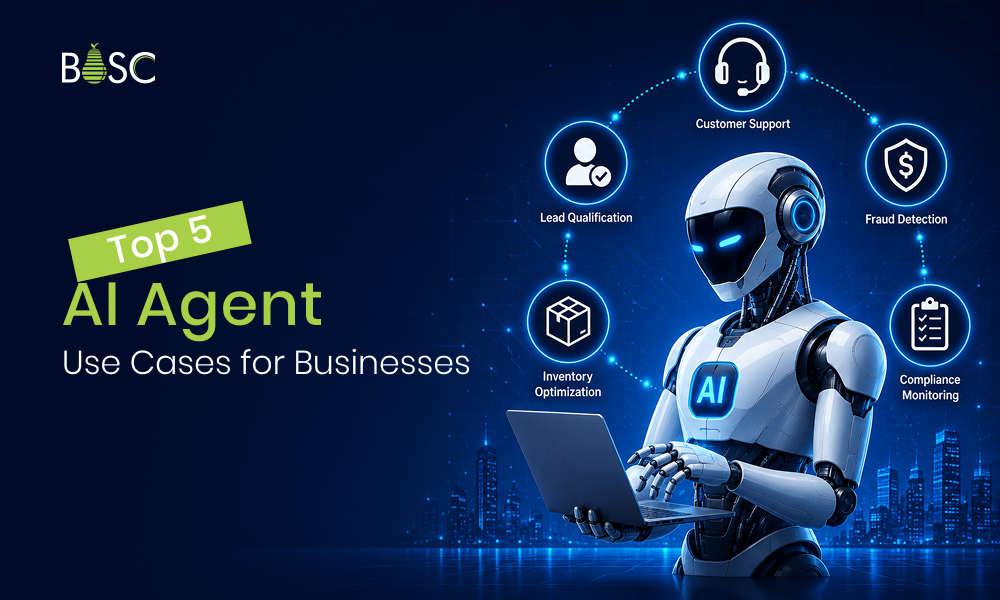
Top 5 AI Agent Use Cases Businesses Are Adopting in 2026
These five AI agents show where businesses can reduce manual effort, improve execution speed, and create measurable operational value.
1. Customer Support Resolution – When Teams Stop Chasing Tickets
As your ticket volume grows, support pressure builds quickly across business operations. Customers grow while agents fail in context-switching across systems, and customers repeat the same issue across channels. Teams spend too much time searching for documentation and prior cases, and escalations occur later than they should because routing is still manual.
A practical AI support agent earns its place when it can move the ticket forward inside your workflow, not just produce text. It can identify the issue, capture the missing details needed to act, resolve routine requests automatically, and route more complex cases to the right team.
What an AI agent does for you
- Routine Issue Resolution: Automatically resolves repetitive tier-1 requests such as password resets, order status checks, account updates, and appointment changes.
- Ticket Qualification and Routing: Classifies intent, captures required information, and routes cases based on urgency, complexity, and support type.
- Faster Agent Resolution: Surfaces relevant documentation, prior case history, and next-step guidance so agents spend less time researching and more time resolving.
For support teams, the harder part is usually not building another chatbot. It involves deciding which requests the agent can close on its own, which need approval, and where the handoff should occur. BOSC designs an AI Customer Support Agent for support workflows, with those rules built into the system from the start.
Real-world use case
A customer opens a support request about a locked account. The agent verifies identity through connected systems, checks account status, resets access if permitted by policy, and updates the case record in the CRM.
If the request falls outside approved conditions, it collects the missing details and routes the ticket to the correct support queue with the full context already attached. The result is fewer handoffs, shorter resolution times, and support queues.
2. Lead Qualification & Sales Outreach – When Sales Talk Only to Serious Buyers
Your sales team is not inefficient at qualifying or pitching prospects. It’s the incomplete context around each inbound lead that slows everything down. By the time a prospect is followed up, qualified, and routed correctly, the window has already narrowed.
A lead qualification & outreach agent is a task-focused system that sits between your inbound channels, such as forms, website chat, email, calls, and your CRM. It qualifies for interest, captures the right details, and triggers the next step in accordance with defined rules.
Instead of stopping at a reply, it helps protect speed-to-lead, maintains the latest CRM records, and gives sales representatives the information needed to act swiftly.
What an AI agent does for you
- Lead Qualification: The agent analyzes the potential lead’s intent against your defined criteria, collects any missing details, and scores or routes the lead.
- Automated Multi-Channel Follow-ups: Conducts personalized outreach via email and follow-ups, tailoring the tone to the prospect’s previous interactions.
- CRM Creation and Enrichment: Creates or updates CRM records automatically so lead data, source details, and qualification notes are recorded without manual entry.
- Sales-Ready Handoffs: Provides a structured lead summary that includes what the prospect asked, the information captured, and the actions already taken.
Real-world use cases
A pricing-page lead submits a form after hours. The agent replies instantly, qualifies, creates a CRM record, schedules a meeting, and sends the rep a summary. A practical KPI that can be targeted here is response time, moving from hours to minutes.
When you automate your discovery phase, you see improvements in response time, contact rate, MQL→SQL/qualification rate, meeting-set rate, and lead-to-opportunity conversion.
BOSC builds AI Sales Engagement Copilots when inbound demand exists, but the first sales response still depends too much on speed, memory, and individual rep discipline.
3. Financial Risk & Fraud Detection – Catching Problems While They’re Still Small
Discrepancies are typically caught during end-of-month reconciliations or annual audits, long after you realize a loss has occurred. By then, finance teams are no longer preventing the issue. They are tracing it back across approvals, transactions, vendors, and account changes.
A financial risk and fraud detection AI agent evaluates financial transactions. This also includes keeping track of your financial systems, such as ERP/AP, payment gateways, bank accounts, and refunds, monitoring money flow continuously rather than waiting for a scheduled review.
What an AI agent does for you
- Suspicious Activity Detection: Flags account takeovers, unauthorized transfers, unusual login behavior, and other signs of fraud before transactions are completed.
- Detects Anomalies Early: Identifies duplicate invoices, unusual subscription spikes, and bank activity that falls outside normal procurement or payment patterns.
- Cross-System Correlation: Connects vendor or customer changes across ERP entries, payment activity, CRM order context, and bank payout updates.
- Continuous Reconciliation: Automatically matches bank statements to ledger entries across multiple entities or currencies, flagging only the mismatches.
Real-world use case
A new vendor is added, and a payout is scheduled within 30 minutes. The agent flags it because (1) the bank account is new, (2) the amount is higher than that vendor category’s norm, and (3) the approver is not the usual owner for that cost center.
It automatically pauses the payout and requests verification from the designated approver. Then the agent opens a case with the change history and related invoices. It only releases the payment when the approval chain is satisfied.
Finance is one area where a generic agent can create more risk than value. BOSC’s AI Agent Development Services fit here because the agent must be built around the company’s financial controls, risk tolerance, and audit expectations, not a standard fraud-detection template.
4. Supply Chain & Inventory Optimization – Knowing What You’ll Need Before You Run Out
Inventory problems usually start before anyone notices them. Demand changes, supplier delays, and scattered data across ERP systems, e-commerce platforms, and spreadsheets make real-time replenishment management harder.
The result is familiar: some items are overstocked and tie up working capital, while others run out too early, resulting in missed sales, delayed fulfillment, and customer frustration.
A supply chain and inventory optimization agent creates value by continuously monitoring demand, stock positions, lead times, and supplier signals, and triggering the next replenishment step in accordance with defined rules.
Instead of waiting for someone to catch a low-stock alert and investigate it manually, the agent helps keep inventory aligned with actual demand while reducing unnecessary carrying costs.
What an AI agent does for you
- Predictive Reordering: Analyzes your sales velocity, seasonality, promos, lead times, and current demand signals to automatically draft purchase orders.
- Dynamic Lead-Time Adjustment: Monitors external factors, such as shipping delays or vendor performance, automatically adjusting buffer stock levels.
- Vendor Coordination: When a threshold is met, the agent reaches out to vendors directly via email or API to confirm availability and pricing.
- Exception Handling: Manages cases like supplier delays, partial shipments, and sudden demand spikes, then routes decisions to the right owner with a clear summary.
Real-world use case
A top-selling SKU starts trending up mid-week. The agent sees your weeks-of-supply drop below the threshold, pulls the inbound ETA, and assesses the risk of the lead time. It recommends a store-to-store transfer from a slower location, plus a replenishment order sized to your service-level target. If the action exceeds your limit, it routes for approval.
This can reduce stockouts, expedited shipping exceptions, and inventory holding costs. The AI agent used here ensures consistent, controlled decisions that prevent runout or overbuy issues.
Our build Marketplace Management Solutions helps to manage inventory across e-commerce channels and connect demand signals, stock positions, and fulfillment workflows in one place.
5. Compliance & Regulatory Monitoring – Staying Compliant Without Constant Checking
A single missed policy violation can escalate into a massive regulatory fine if you keep compliance a once-a-year audit event. Missing approvals, incomplete evidence, and policy exceptions often stay hidden until audit prep begins. By then, teams are forced to trace them manually across email, chat, CRM records, vendor documents, and financial logs
A compliance agent is a task-specific workflow layer that sits across your data streams, like Slack, email, CRM, and financial logs. It continuously monitors interactions against your internal controls and regulatory requirements, rather than waiting for a human review cycle.
What an AI agent does for you
- The Engineering Reality: These agents are “policy-aware,” mapping your legal and operational requirements into a structured Knowledge Base (RAG). This allows the agent to evaluate complex interactions, such as detecting subtle “insider trading” patterns or flagging PII (Personally Identifiable Information) in unsecured channels.
- Watches Control Signals: Checks access records, approval chains, policy attestations, vendor docs, and key logs, and flags missing or overdue items.
- Evidence Collection: Automatically gathers audit evidence from connected systems, reducing the manual effort for compliance reviews or customer security requests.
Real-world use case
A customer requests updated SOC 2 evidence while your renewal process is already underway. The agent assembles the required evidence pack from connected systems, identifies two missing access reviews, and routes those tasks to the correct system owners.
Once the reviews are completed, the audit packet is automatically updated, so the compliance team does not have to restart the collection process manually. The result is audit preparation that runs as an ongoing process rather than a last-minute effort.
We engineers AI Back-Office Workflow Automation for compliance workflows that require continuous monitoring of approval chains, policy gaps, and evidence collection across systems.
How to Choose Your First Agent
Your first best agent usually meets most of these conditions:
| Selection criteria | Ideal first agent | Avoid for now |
| Complexity | A frequent, repeatable task with a clear finish line, such as “lead is routed,” “ticket is categorized,” “evidence pack is prepared.” | Work that needs multi-step judgment, strategy, or persuasion to reach a conclusion |
| Data access | Data already lives in systems you trust (CRM/ERP/helpdesk) and can be accessed via secure APIs | Inputs are messy or incomplete (scanned PDFs, random notes, inconsistent spreadsheets) |
| Error margin | A human can verify in seconds and undo mistakes easily (approve/correct before action) | Outcomes that cannot be undone once triggered and have no human review step built into the workflow |
| Workflow impact | Cuts a known “friction tax” (manual triage, routing, data entry, evidence chasing) | Mostly convenience improvement with no measurable time/risk reduction |
| Risk & permissions | Clear action boundaries, including roles, thresholds, whitelists, and approved actions such as create, update, route, or schedule | Broad authority across sensitive systems without clear approval limits |
| Measurability | Success can be tracked through one or two weekly KPIs, such as response time, backlog, stockouts, or audit prep hours | Success is mostly subjective or hard to attribute |
| Handoff clarity | Clear escalation to a named person or team, with the relevant context attached | Ownership is unclear, or routing rules are undefined |
| Reliability | Monitoring, logs, retries, and alerts (you can trace what happened) | Silent failures or no audit trail when questioned |
If you’re working through this checklist and finding gaps, like unclear ownership, messy data, and undefined escalation paths, that’s typically where scoping conversations with a development partner are most useful. Our AI Agent development engineers help teams define these parameters with trusted technology partners and engineering-led experts.
Where AI Agents Fit in Your Execution Strategy
AI agents can remove operational drag, but the best starting point is usually a repetitive workflow with a clear finish line, defined permissions, and outcomes you can measure early. The best businesses aren’t chasing agentic demos. They are choosing one high-frequency problem, defining what “done” means, and letting the agent take actions within your systems.
That discipline matters because not every agent initiative will justify the cost or complexity. Reuters report on Gartner suggests that over 40% of agentic AI projects may be scrapped by 2027 due to cost and unclear outcomes.
That’s where the starting point matters more than the ambition. BOSC Tech Labs works with businesses to identify the right first workflow, define the agent’s action boundaries, and build measurable outcomes from week one. Contact us today.
Frequently Asked Questions
Which business function usually benefits first from AI agents?
Most teams see the first wins in Customer Support and Sales/RevOps, because the work is high-volume, repetitive, and already lives inside your systems (helpdesk + CRM). Agents can triage, route, fill in fields, draft replies, schedule meetings, and maintain consistent logs.
Do AI agents require major system changes before implementation?
Usually no. You don’t need a rip-and-replace. The practical path is:
- Connect the systems you already use (CRM/helpdesk/ERP) via secure APIs.
- Clean up the minimum data the workflow depends on.
- Start with a narrow use case and expand once it’s stable.
Can AI agents make decisions without human oversight?
They can, but you typically shouldn’t start that way. The safe pattern is:
- Begin with recommend/draft/route (human approves)
- Move to limited autonomy only for low-risk actions (e.g., create a ticket, tag a lead, offer meeting slots)
- Keep human approval for high-stakes actions (money movement, compliance commitments, customer credits above a threshold)
Oversight is more about guardrails, thresholds, and audit logs.
What type of teams benefit most from AI agents?
Teams that have:
- Clear workflows (a defined “done” state)
- Repeatable volume (daily/weekly tasks)
- Data in systems of record (not trapped in inboxes and tribal knowledge)
- A process owner who can set rules and measure outcomes
In practice, that’s often operations-led SMBs and mid-market teams in support, sales ops, finance ops, supply chain, and compliance.