The best generative AI development companies for US businesses ship live products, not demos. We compared nine on reviews, team size, US presence and pricing, so you can build a shortlist of three in one read.
BOSC Tech Labs wrote this guide, and we are on the list. We build AI agents, RAG systems and LLM features for SMB and mid-market teams, and we scored ourselves on the same criteria as every other firm here.
This guide is for founders, CTOs and operations leaders at small and mid-sized US companies. You get a comparison table, a short profile of each firm, a hiring checklist, cost ranges and the red flags to avoid.
Ratings and company facts were checked in November 2026. Ratings change often, so open each firm’s Clutch profile before your first call.
Key takeaways:
- Shortlist by fit for your use case, not by a firm’s position on any list.
- Read the newest client reviews and ask to see live production systems, not demos.
- Generative AI development cost starts around $5,000 for a simple feature; begin with a paid pilot.
- Agree in writing who owns the code, prompts, model weights and data before you sign.
How we compared these generative AI development companies
We judged every firm on the same six criteria: live AI projects, recent client reviews, US presence, team size, AI services offered and how clearly it shares pricing. No firm paid to be included.
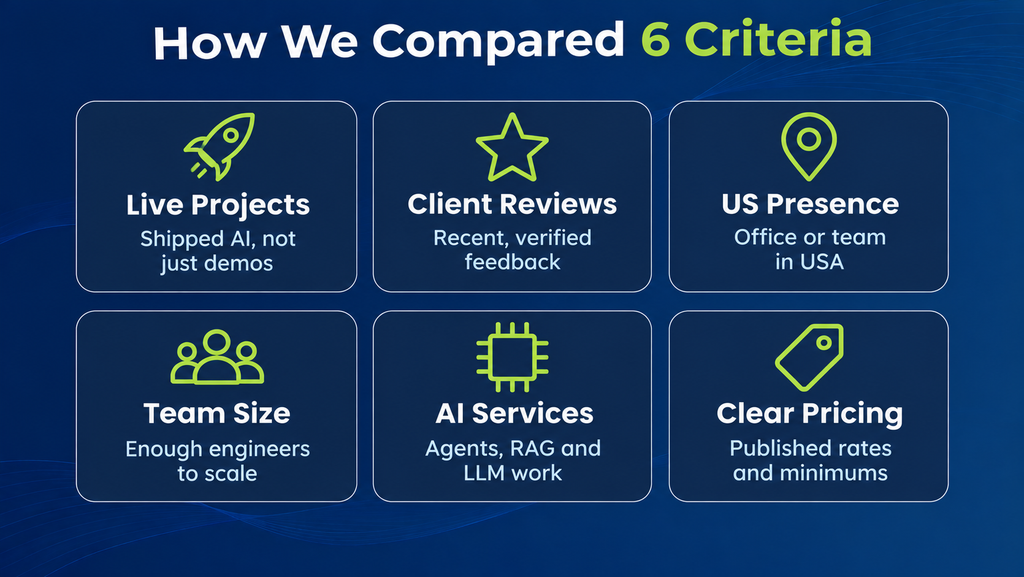
The six criteria work like this:
- Live projects: the firm shows AI systems running in production, not only prototypes or concept videos.
- Client reviews: recent, verified feedback on Clutch, with the rating and review count as of November 2026.
- US presence: a US office, a US legal entity or a team that overlaps with US working hours.
- Team size: enough engineers to staff a project and cover holidays or turnover.
- AI services: hands-on work with AI agents, RAG (retrieval-augmented generation, which answers from your own documents) and large language models.
- Clear pricing: published hourly rates or minimum project sizes, so you can budget before the first call.
When buyers ask us how to vet a vendor, we tell them to read the newest Clutch reviews first. The star rating matters less than whether recent clients describe live launches or only prototypes.
BOSC Tech Labs appears first because we wrote this guide. The other eight follow the order of our earlier list, not a quality ranking.
Top generative AI development companies in the USA at a glance
Startups and SMBs building a first AI product should look at BOSC Tech Labs, NineTwoThree AI Studio or SynergyLabs. Enterprises often favour LeewayHertz or SoluLab, while data-heavy projects suit Addepto or RTS Labs.
The table below compares all nine generative AI development firms on the facts that matter for a first call.
| Company | Best for | Founded | HQ (US office) | Team size | Rating (reviews) |
|---|---|---|---|---|---|
| BOSC Tech Labs (our company) | Agents, assistants and LLM features for SMB and mid-market teams | 2019 | Gandhinagar, India (Burbank, CA) | 51–200 | Clutch 5.0 (3+) |
| AccelOne | Product development plus staff augmentation | 2013 | Kirkland, WA | 51–200 | Clutch 4.9 (12+) |
| NineTwoThree AI Studio | AI consulting and product design for funded startups | 2012 | Danvers, MA | 51–200 | Clutch 4.9 (38+) |
| SynergyLabs | SaaS and mobile apps with AI features | 2016 | Gurugram, India (Dover, DE) | 11–50 | Clutch 4.7 (5+) |
| RTS Labs | Data science and AI consulting, onshore | 2010 | Glen Allen, VA | 51–200 | Trustpilot 3.7 |
| LeewayHertz | Enterprise generative AI customization | 2007 | USA and India (San Francisco, CA) | 51–200 | Clutch 4.7 (9+) |
| Addepto | Data engineering, LLM and machine learning consulting | 2018 | Warsaw, Poland (New York, NY) | 51–200 | Clutch 4.9 (18+) |
| eSparkBiz | Large custom software builds with AI | 2010 | Ahmedabad, India (Middletown, DE) | 201–500 | Clutch 4.9 (62+) |
| SoluLab | AI combined with blockchain | 2014 | Los Angeles, CA (New York, NY) | 201–500 | Clutch 4.9 (46+) |
Use the “Best for” column to cut the list to three firms, then read their profiles below.
The 9 companies in detail: what each does best
These nine generative AI development companies all build for US clients, but their strengths differ. Some focus on SMB products, others on enterprise data, staff augmentation or blockchain.
1. BOSC Tech Labs (our company)
BOSC Tech Labs is best for SMB and mid-market teams that want assistants, agents or LLM features built and then run reliably in production.
Most of our client work is long-term: 30+ of our clients have stayed with us for three years or more. We stay on after launch to monitor, maintain and improve each system as usage grows.
Founded in 2019 in Gandhinagar, Gujarat, BOSC has a US office in Burbank, California, and 90+ AI-skilled engineers. Our generative AI development services include LLM development services, AI consulting and data engineering.
Clutch reviewers rate BOSC 5.0 from 3+ reviews. Choose BOSC if you want one partner for the data, cloud and AI layers, with support after launch.
2. AccelOne
AccelOne, founded in 2013 in Kirkland, Washington, suits US firms that want product development and staff augmentation from one vendor. Clutch reviewers rate it 4.9 from 12+ reviews and praise its responsiveness.
Its services cover product development, AI development with staff training, staff augmentation, custom software, and mobile and web apps. Choose AccelOne if you also want your own team trained on AI.
3. NineTwoThree AI Studio
NineTwoThree AI Studio, based in Danvers, Massachusetts since 2012, suits funded startups and brands that need AI consulting plus product and UX design. It reports 150+ products built.
Clutch reviewers rate it 4.9 from 38+ reviews, often mentioning on-time delivery. Choose NineTwoThree if design quality and a product playbook matter as much as the model.
4. SynergyLabs
SynergyLabs, founded in 2016 in Gurugram, India, with a US office in Dover, Delaware, suits SaaS and mobile products that need AI features. It reports 250+ projects delivered.
Its services include SaaS and mobile apps, API development and enterprise solutions; Clutch rates it 4.7 from 5+ reviews. With 11–50 staff, check its capacity for larger builds.
5. RTS Labs
RTS Labs, based in Glen Allen, Virginia since 2010, suits companies that want data science and AI consulting from a US-only team. It reports 100+ AI-driven solutions across industries.
Its services are AI development and consulting, data science and engineering, and custom software. Its Trustpilot rating is 3.7. Choose RTS Labs if your project depends on data engineering.
6. LeewayHertz
LeewayHertz, founded in 2007, suits enterprises that need generative AI customization at scale. It has been part of The Hackett Group since 2024 and works from the USA and India.
It reports 50+ AI solutions, plus data engineering, web, custom software and IoT work; Clutch rates it 4.7 from 9+ reviews. Choose it for enterprise programs that need a consulting group behind delivery.
7. Addepto
Addepto, founded in 2018 in Warsaw, Poland, with a New York office, builds custom generative AI solutions on strong data engineering. It reports 70+ projects and 40+ AI experts.
Its services cover AI and data consulting, LLM development and machine learning consulting; Clutch rates it 4.9 from 18+ reviews. Choose Addepto when your data platform needs work first.
8. eSparkBiz
eSparkBiz is one of the larger generative AI development companies here, with 201–500 staff in Ahmedabad, India, and a US office in Middletown, Delaware. It reports 1,000+ projects since 2010.
It is ISO 9001:2015 certified and offers software, apps, AI, IoT and testing; Clutch rates it 4.9 from 62+ reviews. Choose eSparkBiz when AI is one part of a larger software build.
9. SoluLab
SoluLab, founded in 2014 in Los Angeles, suits companies that want AI and machine learning alongside blockchain work. It also has offices in New York and Ahmedabad, India.
Its services include AI and machine learning, blockchain consulting, software development and IoT; Clutch rates it 4.9 from 46+ reviews. Choose SoluLab if your roadmap mixes AI and blockchain.
How to choose a generative AI development company
Start with the business problem and the data you already have, then shortlist three firms that have shipped that kind of system. Compare them on a short paid pilot, not on slide decks or hourly rates alone.
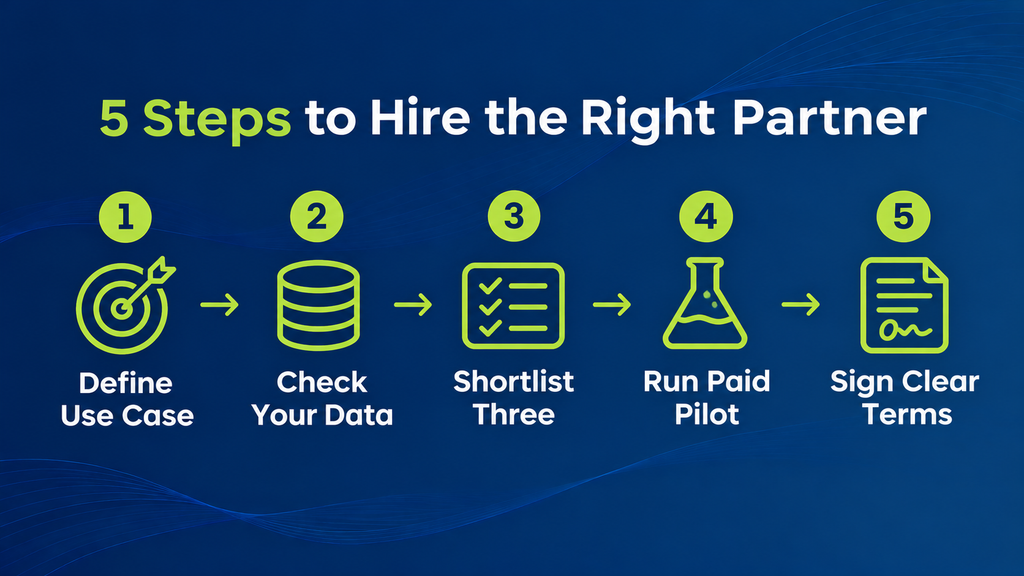
Most generative AI development companies will say yes to almost any brief, so the checklist below does the filtering for you. Ask every firm on your shortlist for these six things:
- Two or three production examples in your use case, with a client reference you can call.
- Written terms on who owns the code, prompts, fine-tuned model weights and your data.
- Proof of data security, such as a SOC 2 report or an equivalent audit, plus HIPAA experience for health data.
- A named team, the hours each person spends on your project, and working-hour overlap with you.
- A paid pilot with one clear success metric, such as answer accuracy or hours saved per week.
- A plan for monitoring, updates and support after launch.
In our discovery calls, we look at the client’s data before we talk about models. When a project slips, the cause we see most often is data that was scattered or not ready, not the model itself.
If you have no in-house AI lead, a few days of independent AI consulting can turn your idea into a brief that firms can quote against. A good AI development partner welcomes a clear brief, because it cuts risk for both sides.
The strongest generative AI development companies will also tell you when AI is the wrong tool for a task. That honesty in the sales stage is a good sign for the build stage.
Generative AI development cost and timelines
Generative AI development cost starts around $5,000 for a simple feature and rises with data work, integrations and compliance. Hourly rates among the firms here run from about $25 to $150.
The table below shows typical budgets and timelines by project size, as of November 2026.
| Project size | Typical example | Starting budget | Typical timeline |
|---|---|---|---|
| Small | Chatbot or AI feature in an existing app | From about $5,000 | 2–3 months |
| Pilot | Proof of concept on your own data | Agency minimums apply (ours: $10,000) | 4–8 weeks |
| Enterprise | Integrated system with security reviews | Quoted after discovery | 4–5 months |
Most of the gap between a small and an enterprise budget comes from data preparation, integrations and security reviews, not from the model itself.
Our minimum project size on Clutch is $10,000, and we usually suggest a short paid pilot first. A pilot shows real usage and running costs before you commit to a full build budget.
If you are weighing a fully custom model, our breakdown of what a custom AI model costs to build covers each cost line.
Plan for running costs too: model API fees or hosting, monitoring and updates continue every month after launch. Ask the generative AI development companies on your shortlist to estimate them in writing.
In-house team vs outsourced generative AI development services
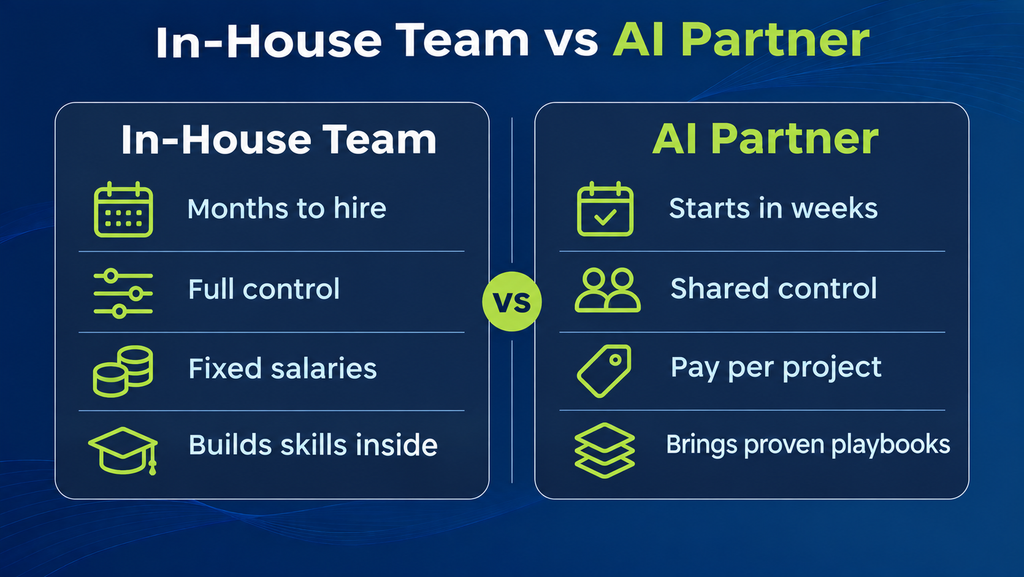
Outsource when you need a first version fast or lack AI skills; hire in-house when AI becomes core to your product and needs daily work. Many companies start with a partner and build a team later.
Here is how the two options compare on the points that usually decide it.
| Factor | In-house team | Outsourced partner |
|---|---|---|
| Time to start | Months to hire generative AI developers | Weeks, with a team already in place |
| Cost model | Salaries, benefits and tools | Per project, per sprint or a monthly retainer |
| Control | Full, day to day | Shared, set by the contract |
| Skills | Built inside your company | Proven playbooks from many projects |
| Best when | AI is core to the product and ongoing | You need speed or a first version |
The takeaway: a partner buys speed and proven methods, while an in-house team buys control and skills that stay.
A hybrid works well for many SMBs: the partner builds custom generative AI solutions and documents them, then your team takes over. Our guide to integrating LLMs into existing workflows shows what that handover involves.
When you compare generative AI development services, ask how each firm trains your staff during the handover. A two-week shadowing period is a reasonable request.
Strong generative AI development companies put the handover plan in the proposal, not in a later change request.
Red flags when hiring generative AI development companies
The biggest red flags are demos without live clients, a fixed price quoted before anyone has seen your data, and vague answers about who owns the code and how your data is used or stored.
Slow down, or walk away, if you see any of these:
- The firm shows only demos and cannot name a client running its system in production.
- It quotes a fixed price before it has looked at your data or your current systems.
- It gives vague answers on IP ownership, or on whether your data will train other models.
- It has no plan for monitoring, model drift (quality slipping over time) and updates after launch.
- Every proposal shows the same senior experts, who then disappear once the contract is signed.
The NIST AI Risk Management Framework is a free reference for the risk questions worth raising. Serious generative AI development companies answer them without hesitation.
Frequently asked questions about hiring a generative AI partner
What does a generative AI development company do?
A generative AI development company scopes, builds, connects and maintains software that uses large language models, such as chatbots, assistants and content tools, on your own data. Advice without building is consulting.
How long does a generative AI proof of concept take?
A focused proof of concept usually takes 4 to 8 weeks for one use case with data that is ready to use. Expect longer if your data first needs cleaning, labelling or new access permissions.
Are generative AI development companies with offshore teams a good choice for US businesses?
Yes, if the firm has a US entity or office, several hours of daily overlap with your team and clear IP terms. Offshore teams often cost less, but they need clearer written specs and regular demos.
Do I need clean data before I hire a generative AI partner?
No. A good AI development partner assesses your data first and tells you what to fix. Data preparation is often the largest part of early work, so budget time for it in the first phase.
Who owns the code and the model after a generative AI project?
It depends on your contract, so put it in writing. Ask to own the code, prompts, fine-tuned weights and your data; base models from providers such as OpenAI stay under the provider’s licence.
What should a generative AI project proposal include?
A good proposal states the problem and one success metric, the data needed, the technical approach, a pilot phase, build and running costs, the timeline, the named team, and support after launch.
Final verdict: shortlist three and run a paid pilot
The right choice among these generative AI development companies depends on your use case, data and budget, not on a ranking. Pick three that fit, read their newest reviews, and compare them on a paid pilot.
Ask each firm the six checklist questions and the red-flag questions before you sign. The firm that answers clearly and shows live work is usually the safest choice.
Want to see how we build? Browse our case studies or talk to our solutions team about your project.