Introduction
Choosing the right RAG development partner can make a significant difference in how effectively your business uses artificial intelligence. From connecting enterprise data with large language models to improving information retrieval and response accuracy, a well-designed RAG application depends on the right technical expertise.
However, not every development company has the experience required to build secure, scalable, and production-ready RAG applications. Businesses need to evaluate technical capabilities, data integration, security practices, development processes, and ongoing support before making a decision.
This guide explains the important factors to consider when selecting a development partner for your RAG project.
1. Understand Your Business Requirements
Before selecting a RAG development company, identify the business challenges you want to solve. RAG technology supports different applications, but each use case requires a suitable development approach.
Common business applications include:
- Internal Knowledge Management: Helps employees find information across company documents, policies, and reports.
- Customer Support Automation: Provides relevant answers using FAQs, product manuals, and support documentation.
- Enterprise Document Search: Retrieves information from contracts, reports, and business records.
- Research Assistants: Helps teams find relevant information across multiple knowledge sources.
- Technical Documentation Assistants: Supports developers in accessing technical documentation and code resources.
Define your objectives, target users, data sources, expected response accuracy, and integration requirements before discussing the project with potential partners.
A capable development team should understand your business requirements and recommend an appropriate solution rather than introducing unnecessary technical complexity.
2. Evaluate Their RAG Architecture Expertise
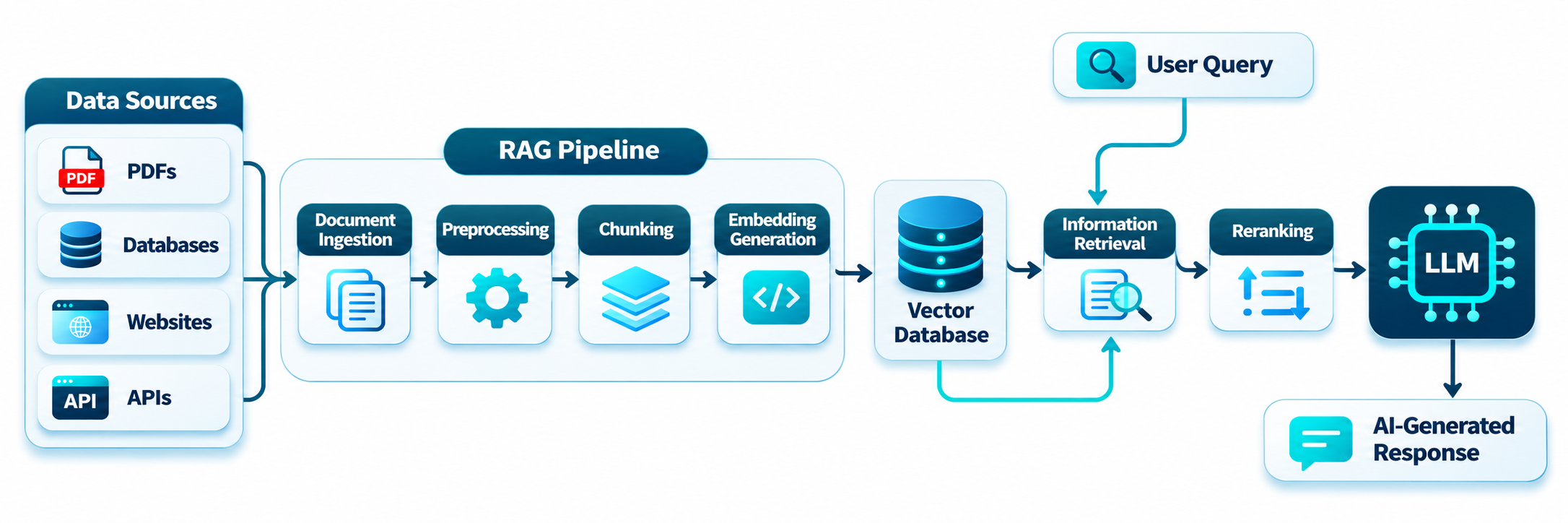
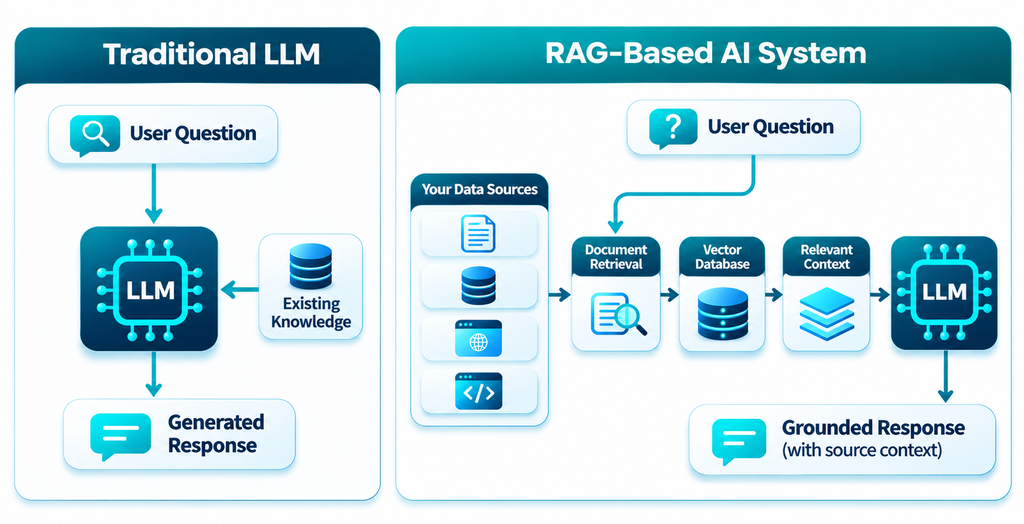
A RAG application involves multiple components that work together to retrieve relevant information and generate context-based responses.
A typical RAG architecture includes:
- Data Ingestion: Collects information from documents, databases, websites, and APIs.
- Data Preprocessing: Cleans and prepares information for further processing.
- Chunking and Embedding: Divides documents into smaller sections and converts them into numerical representations.
- Vector Storage: Stores embeddings in a vector database.
- Information Retrieval: Finds relevant content using semantic search, keyword search, or hybrid search.
- Response Generation: Uses an LLM to generate answers based on retrieved information.
Your development partner should understand these components and explain how they work together.
It is also important to evaluate their knowledge of hybrid search, metadata filtering, reranking, query rewriting, and contextual retrieval. These techniques can improve the relevance of retrieved information and help the application provide more useful responses.
3. Check Data Processing and Integration Capabilities
The quality of a RAG application depends heavily on the information it retrieves. Poorly structured, incomplete, or outdated data can affect the relevance of generated responses.
Therefore, evaluate whether your RAG implementation partner can work with different data formats and enterprise systems.
Important data sources include:
- PDF documents, Word files, and spreadsheets
- Internal databases and structured records
- Websites and knowledge bases
- CRM and ERP platforms
- Cloud storage systems
- APIs and third-party applications
Another important factor is data synchronization. When business information changes, the RAG system should update or reindex relevant content.
For example, if an organization updates its employee policies, the AI assistant should retrieve the latest version instead of providing outdated information.
Ask how the development team handles document extraction, metadata management, duplicate content, version control, and incremental indexing.
A reliable partner should also explain how information flows between existing business systems and the RAG application.
4. Assess Their LLM and Vector Database Knowledge
RAG applications depend on suitable language models and vector databases. Your development partner should understand how to select and integrate these technologies based on your requirements.
Large Language Models
LLMs generate responses using the context retrieved from connected knowledge sources. Different models offer different capabilities in terms of response quality, processing speed, context length, and cost.
Common options include:
- OpenAI models
- Anthropic Claude
- Open-source models such as Llama
Vector Databases
Vector databases store document embeddings and help applications retrieve information based on semantic similarity.
Popular options include:
- Pinecone: A managed vector database for similarity search.
- Weaviate: Supports semantic and hybrid search.
- Milvus: Designed for large-scale vector search.
- Chroma: Commonly used in development environments.
- Qdrant: Supports vector search and metadata filtering.
Comparison of Popular Vector Databases
| Vector database | Key capability | Suitable for |
| Pinecone | Managed vector search | Managed cloud applications |
| Weaviate | Semantic and hybrid search | Knowledge-based applications |
| Milvus | Large-scale vector search | High-volume workloads |
| Chroma | Developer-friendly setup | Prototypes and smaller applications |
| Qdrant | Filtering and similarity search | Applications requiring advanced retrieval |
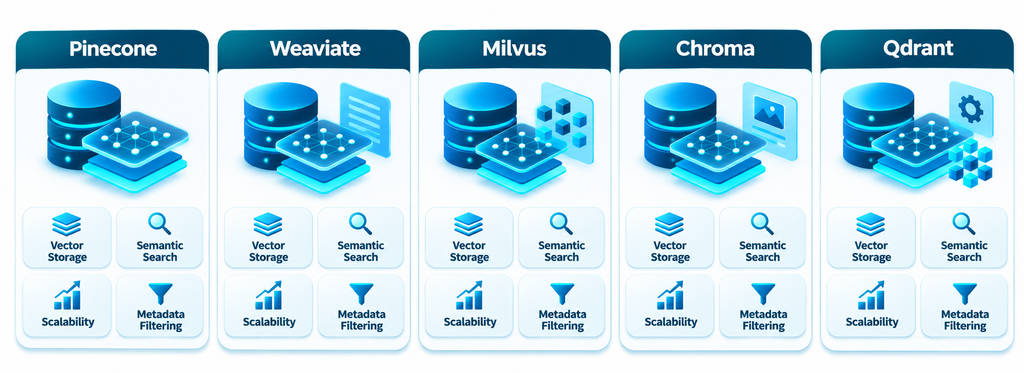
Your development partner should explain the advantages and limitations of each option instead of recommending technologies simply because they are popular.
The right database depends on data volume, infrastructure preferences, filtering requirements, scalability, and overall application architecture.
Businesses looking to implement language models into their existing systems can also explore how to integrate LLMs into existing business workflows.
5. Prioritize Data Security and Privacy
Businesses often connect RAG applications to confidential information, including customer records, financial documents, internal policies, and contracts.
Without proper security measures, these systems may expose sensitive information to unauthorized users.
Evaluate whether your RAG development company implements the following security practices:
- Access Control: Restricts information retrieval based on user permissions.
- Data Encryption: Protects sensitive information during transmission and storage.
- Authentication: Verifies user identities before granting access.
- Role-Based Permissions: Provides different access levels to employees and departments.
- Data Isolation: Separates information belonging to different customers or business units.
- Audit Logging: Records important activities for monitoring and investigation.
Also discuss data retention policies, third-party model providers, hosting environments, and industry-specific compliance requirements.
For example, an employee accessing an HR knowledge assistant should only retrieve information they are authorized to view.
Security should be considered throughout the development process, from document ingestion to information retrieval and response generation.
6. Evaluate Their Approach to Accuracy and Hallucination Reduction
One challenge with generative AI is hallucination. An LLM may generate convincing answers that are not supported by the available information.
RAG helps reduce this risk by providing relevant external context, but it does not completely eliminate hallucinations.
A reliable RAG implementation partner should use appropriate retrieval and evaluation techniques.
Important approaches include:
- Hybrid Search: Combines keyword-based and semantic search.
- Reranking: Reorders retrieved results based on relevance.
- Metadata Filtering: Retrieves information based on specific document attributes.
- Context Optimization: Provides relevant information while avoiding unnecessary content.
- Source Citations: Shows users where the generated information originated.
- Fallback Responses: Allows the system to acknowledge when sufficient information is unavailable.
Ask how the team evaluates retrieval relevance, answer accuracy, and response consistency using real business queries.
Testing should include different query types, incomplete questions, ambiguous requests, and questions that cannot be answered using the available knowledge sources.
7. Check Scalability and Production Readiness
A RAG application that works well during a demonstration may face performance challenges when deployed across an organization.
As users, documents, and queries increase, the system must handle additional workloads efficiently.
Evaluate these important factors:
- Concurrent Users: Can the application handle multiple users simultaneously?
- Data Growth: Can it support increasing document volumes and additional knowledge sources?
- Response Latency: Can users receive responses within an acceptable time?
- Infrastructure: Can computing and storage resources scale with demand?
- Monitoring: Does the system track errors, retrieval performance, and response times?
- Maintenance: Is there a process for updating models and refreshing document indexes?
Also ask whether the partner has experience deploying applications in public cloud, private cloud, or on-premises environments.
A production-ready solution should support your current requirements while allowing future expansion.
8. Review Their Portfolio and Previous Experience
A development company’s technical claims should be supported by relevant project experience.
Review previous projects involving enterprise knowledge assistants, document retrieval systems, customer support automation, or AI-powered search applications.
Consider the following questions:
- What business problem did the project address?
- Which data sources were integrated?
- What technologies and retrieval methods were used?
- How were security and permissions managed?
- What challenges occurred during implementation?
- How was application performance evaluated?
Ask for relevant case studies, technical demonstrations, or client references where available.
Experience with similar data environments and business requirements can help reduce implementation risks.
Also check whether the company can explain the technical decisions behind its previous projects instead of presenting only screenshots or product demonstrations.
9. Understand Their Development Process
A structured development process helps businesses monitor progress and maintain control over technical decisions.
A typical RAG application development process includes:
| Development stage | Key activities |
| Requirement discovery | Understanding business goals, users, and data sources |
| Architecture planning | Selecting LLMs, vector databases, and retrieval methods |
| Proof of concept | Testing the proposed approach using sample data |
| Development | Building the application and integrating data sources |
| Testing | Evaluating accuracy, security, and performance |
| Deployment | Launching the application in the required environment |
| Maintenance | Monitoring and optimizing the application |
Also discuss communication frequency, project management tools, technical documentation, and the process for managing scope changes.
Your development partner should provide clear updates and involve relevant business stakeholders throughout the project.
A well-defined development process also makes it easier to identify technical issues early and manage implementation risks.
10. Compare Pricing and Engagement Models
Development costs depend on several factors, including application complexity, data volume, integrations, infrastructure, model selection, and security requirements.
Before comparing proposals, understand what each quotation includes.
Important RAG Development Cost Components
| Cost component | What to evaluate |
| Initial development | Architecture and application development |
| Data processing | Document extraction, cleaning, and indexing |
| Model usage | LLM and embedding API consumption |
| Infrastructure | Cloud hosting, storage, and database expenses |
| Integration | Connecting existing business systems |
| Maintenance | Monitoring, updates, and troubleshooting |
| Optimization | Improving retrieval quality and performance |
You should also understand the engagement model offered by the company.
Common options include:
- Fixed-Price Projects: Suitable for projects with clearly defined requirements and deliverables.
- Dedicated Development Teams: Useful for long-term development and continuous improvement.
- Time-and-Material Model: Provides flexibility when project requirements may change during development.
Compare the total cost of ownership instead of focusing only on the initial development estimate.
A transparent development partner should explain potential additional expenses, infrastructure requirements, and ongoing operational costs.
11. Look for Ongoing Support and Optimization
RAG applications require regular maintenance after deployment. Business information changes, new documents are added, and user expectations evolve.
Without continuous monitoring, retrieval quality and application performance may decline.
Before selecting a partner, check whether it provides:
- Retrieval and response quality monitoring
- Document indexing and synchronization
- Technical troubleshooting
- Model and infrastructure updates
- Performance and cost optimization
- Security maintenance
- Improvements based on user feedback
Documentation and knowledge transfer are also important. Your internal team should understand how the application works and how routine maintenance is managed.
A long-term development relationship should focus on keeping the application reliable, secure, and aligned with changing business needs.
12. Ask These Questions Before Choosing a RAG Development Partner
Before finalizing a development company, arrange technical and business discussions.
Here are some important questions to ask:
- What experience do you have building production-ready RAG applications?
- How do you choose between semantic search, keyword search, and hybrid retrieval?
- Which vector databases and embedding models do you recommend?
- How do you handle different document formats and frequently updated information?
- What security measures do you implement for confidential business data?
- How do you evaluate retrieval relevance and answer accuracy?
- How do you reduce hallucinations?
- Can the solution integrate with our existing CRM, ERP, and databases?
- How will the architecture support increasing users and data volumes?
- What maintenance and technical support do you provide after deployment?
Pay attention to how clearly the team explains its answers.
A capable partner should discuss technical limitations, potential challenges, and alternative approaches rather than making unrealistic promises.
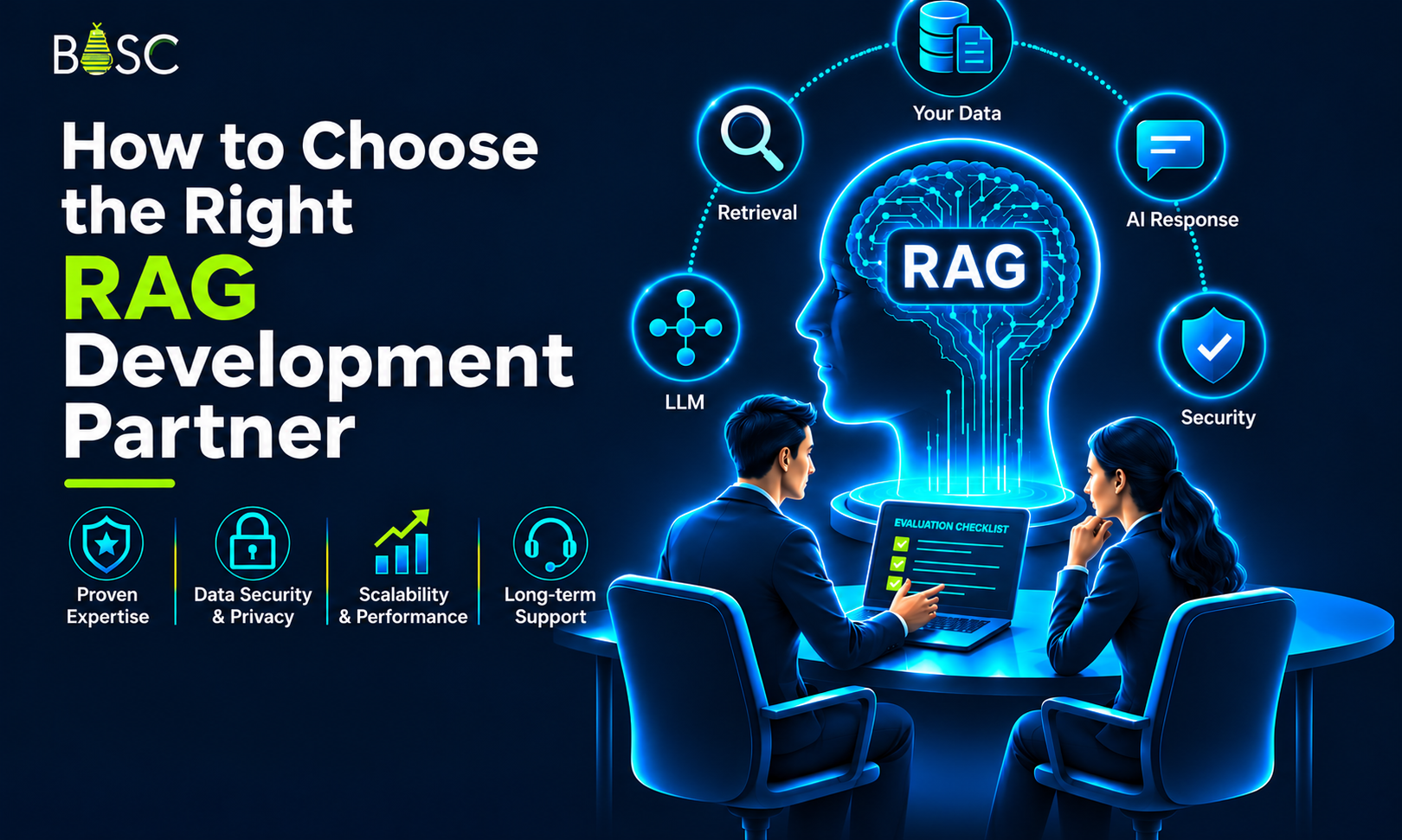
RAG Development Partner Evaluation Checklist
Before making your final decision, use this checklist to compare potential development companies.
- Experience with production-ready RAG applications.
- Knowledge of different RAG architectures.
- Expertise in LLM and vector database integration.
- Experience with enterprise data sources.
- Strong security and access control practices.
- Retrieval accuracy and hallucination evaluation.
- Scalability and deployment capabilities.
- Transparent pricing and development timelines.
- Post-deployment support and maintenance.
- Clear communication and technical documentation.
Evaluating these factors can help businesses make informed decisions and select a development partner that understands their technical and operational requirements.
Common Mistakes to Avoid When Choosing a RAG Development Partner
Businesses sometimes focus on technical capabilities while overlooking important implementation considerations.
Avoid these common mistakes:
1. Choosing Based Only on Pricing
A low quotation may exclude important services such as security implementation, monitoring, integration, and maintenance.
2. Ignoring Data Quality
Poor document preparation, duplicate information, and outdated records can reduce retrieval relevance.
3. Overlooking Security
Internal knowledge sources require appropriate access controls, encryption, and data protection practices.
4. Focusing Only on LLM Selection
Retrieval, preprocessing, vector storage, and evaluation are equally important for building an effective RAG application.
5. Skipping Real-World Testing
A successful prototype does not guarantee production readiness. Applications should be evaluated using realistic business queries and different data scenarios.
6. Ignoring Long-Term Support
Businesses should understand how the application will be maintained, monitored, and optimized after launch.
Evaluating these factors early can help reduce development risks and improve the chances of a successful implementation.
Conclusion
Choosing the right RAG development partner involves more than comparing technologies and development costs. Businesses should evaluate technical expertise, data integration capabilities, security practices, retrieval accuracy, scalability, and long-term support.
A capable development team should understand your business requirements, recommend the right architecture, and build a RAG application that works effectively with your existing systems.
At BOSC Tech Labs, businesses can explore our RAG development services to build AI-powered applications that connect language models with relevant enterprise knowledge. Whether you are planning an enterprise knowledge assistant, intelligent document search system, or AI-powered customer support application, the right development approach can help turn your business data into actionable insights.
Connect with our team to discuss your RAG application requirements.
Frequently Asked Questions
1. What should I look for in a RAG development partner?
Look for experience in RAG architecture, data processing, LLM integration, vector databases, security, and production deployment. The partner should understand your requirements and provide a clear development and maintenance strategy.
2. How much does it cost to develop a RAG application?
Costs depend on application complexity, data volume, model selection, integrations, infrastructure, and security requirements. A proof of concept generally requires fewer resources than a large enterprise implementation.
3. Which technologies are used in RAG development?
Common technologies include OpenAI models, Llama, Pinecone, Weaviate, Milvus, Qdrant, LangChain, and LlamaIndex. The selection depends on application requirements.
4. How long does it take to build a RAG application?
The timeline depends on data complexity, integrations, security requirements, features, and testing. A proof of concept generally takes less time than a production-ready enterprise application.
5. Can RAG applications integrate with existing enterprise systems?
Yes. RAG applications can connect with CRM platforms, ERP systems, databases, cloud storage, internal document repositories, and third-party applications through APIs and suitable integration methods.