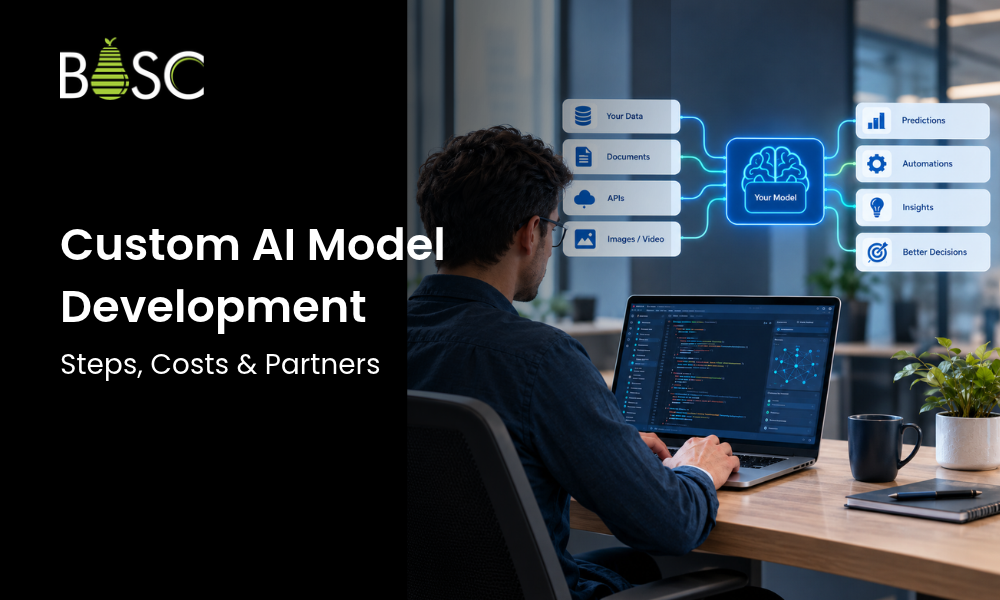
Most projects don’t stall in custom AI model development because the algorithms are hard. They stall because the team picked the wrong approach, started with messy data, or hired a partner before defining what “done” looks like. This guide fixes that. It walks through the full AI model development process, puts current cost bands next to each approach, and gives you a scorecard for choosing a custom AI development company.
Quick answer: Custom AI model development is the process of designing, training or fine-tuning, testing, deploying and monitoring an AI model on your own data to solve one specific business problem. Most business use cases are served by retrieval (RAG) or fine-tuning an existing model, not by training from scratch. Published estimates put a typical production project at roughly $25K to $200K and one to five months, plus 20 to 35 percent of the build cost each year to run it.
What Is Custom AI Model Development?
A custom AI model is a model trained, fine-tuned or grounded on your data to do one job better than a general-purpose tool can. That job might be predicting churn, flagging fraud, reading invoices, routing support tickets or answering questions from internal documents.
Custom AI models differ from off-the-shelf AI in three ways:
- The data is yours. The model learns your customers, your products and your edge cases instead of averages from the public internet.
- The success metric is yours. You decide whether precision, recall, latency or cost per prediction matters most.
- The control is yours. You choose where the model runs, who can see the data and how it behaves when it is unsure.
Custom AI development is broader than modeling. With custom AI models, the model is often the smaller part of the work. Data pipelines, integration, evaluation and monitoring usually take more effort than training does.
Do You Need a Custom AI Model? Start With the Decision Ladder
Before you commit to custom AI model development, check whether a cheaper rung on the ladder already solves the problem. Climb one rung at a time and stop when the results are good enough.
| Approach | What it changes | Typical cost* | Choose it when |
| Prompting or API integration | The instructions given to a model | $5K to $50K | The task is standard and a strong general model already does it well |
| Retrieval-augmented generation (RAG) | What the model knows | $25K to $60K (enterprise: $150K+) | Answers must come from your changing documents, with citations |
| Fine-tuning | How the model behaves | $40K to $200K | Tone, format, vocabulary or task accuracy is still short after RAG |
| Training from scratch | Everything | $200K to millions | You have a novel data type, extreme privacy limits, or you are building a product around the model itself |
Ranges are drawn from recent vendor-published cost guides and vary widely. Treat them as orders of magnitude, not quotes.
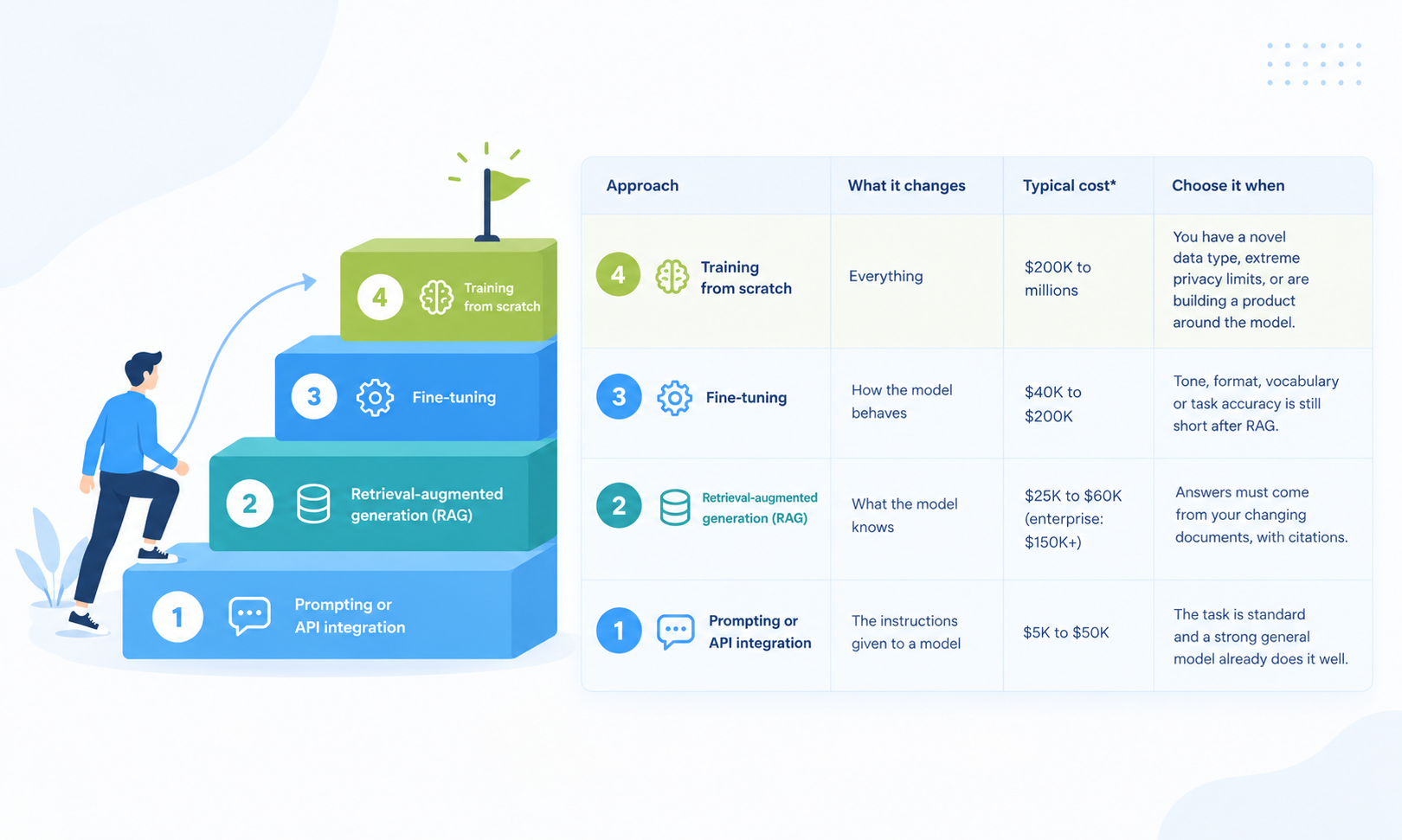
Two rules of thumb hold up well. In AI model development, retrieval changes what a model knows, while fine-tuning changes how it behaves, so build retrieval first and fine-tune only when style or format is still the bottleneck. And if you are tempted to build an AI model from scratch, know that it is almost never justified for a business application.
Custom is also the right call when your data is a competitive asset, when regulations limit where data can go, or when a generic model’s errors are costly enough that a few points of accuracy pay for the project.
For the business case behind starting at all, see Why Businesses Need AI Transformation to Stay Competitive.
How to Build an AI Model: The 9-Step AI Model Development Process
If you are asking how to build an AI model, this is the sequence that holds for predictive models and generative systems alike. Each step ends with a deliverable and a go or no-go gate, so you can stop cheaply instead of discovering problems in step eight.
Step 1: Define the problem and the success metric
Write one sentence: “We will predict X so that Y team can do Z, and we will call it a success if metric M reaches target T.” Tie M to money or time saved, such as hours of manual review removed or percentage of at-risk accounts caught. Deliverable: a one-page problem brief. Gate: a named business owner signs off.
Step 2: Check feasibility and data readiness
Inventory the data you have, where it lives, how much is labeled, how far back it goes and who is allowed to use it. Check for gaps, duplicates and leakage, where information from the future sneaks into training data. Deliverable: a data audit. Gate: enough representative data exists, or you have a plan to collect it.
Step 3: Prepare the data
Clean, deduplicate, label and anonymize. Split the data into training, validation and test sets before you look at results, and split by time when the model will predict the future. Lock the test set and do not touch it until the end. Deliverable: versioned datasets and a documented pipeline.
Step 4: Build a baseline
Start with something deliberately simple, such as a rules-based approach, linear regression or a decision tree. The baseline tells you whether the data contains signal and gives every later improvement a number to beat. Gate: if a simple baseline already meets the business target, stop and ship it.
Step 5: Choose the approach and architecture
Match the method to the problem. Gradient-boosted trees remain hard to beat on structured business data. Neural networks suit images, audio and sequences. Language tasks usually start with an existing foundation model plus retrieval or fine-tuning, as the decision ladder showed.
Niche image and video problems are a common example: custom vision models are trained on your own images and footage because generic detectors often miss domain-specific objects and conditions.
Step 6: Train and evaluate
Train, tune and compare against the baseline on the validation set. Choose metrics that match the cost of errors: precision when false alarms are expensive, recall when misses are, and F1 or ROC-AUC when you need a balance. Check performance by segment, not just overall, to catch bias. Deliverable: an evaluation report on the locked test set.
Step 7: Run a prototype and pilot
Put the model in front of real users on a small slice of real work, ideally in shadow mode, where it makes predictions but humans still decide. Measure business results, not just model scores. Gate: the pilot beats the current process on the metric from step one.
Step 8: Deploy and integrate
Wrap the model in an API or batch job, connect it to the CRM, ERP, storefront or support tool where decisions happen, and add fallbacks for when it fails or is unsure. Integration is where many pilots die, so plan it in step two, not step eight.
If the model reads camera feeds, plan for edge or cloud inference as well. Vision-based automation systems show how that fits into an operational workflow, and IT Solutions for Manufacturing: 8 Systems That Cut Downtime, Defects and Cost covers plant-floor integration.
Step 9: Monitor, retrain and govern
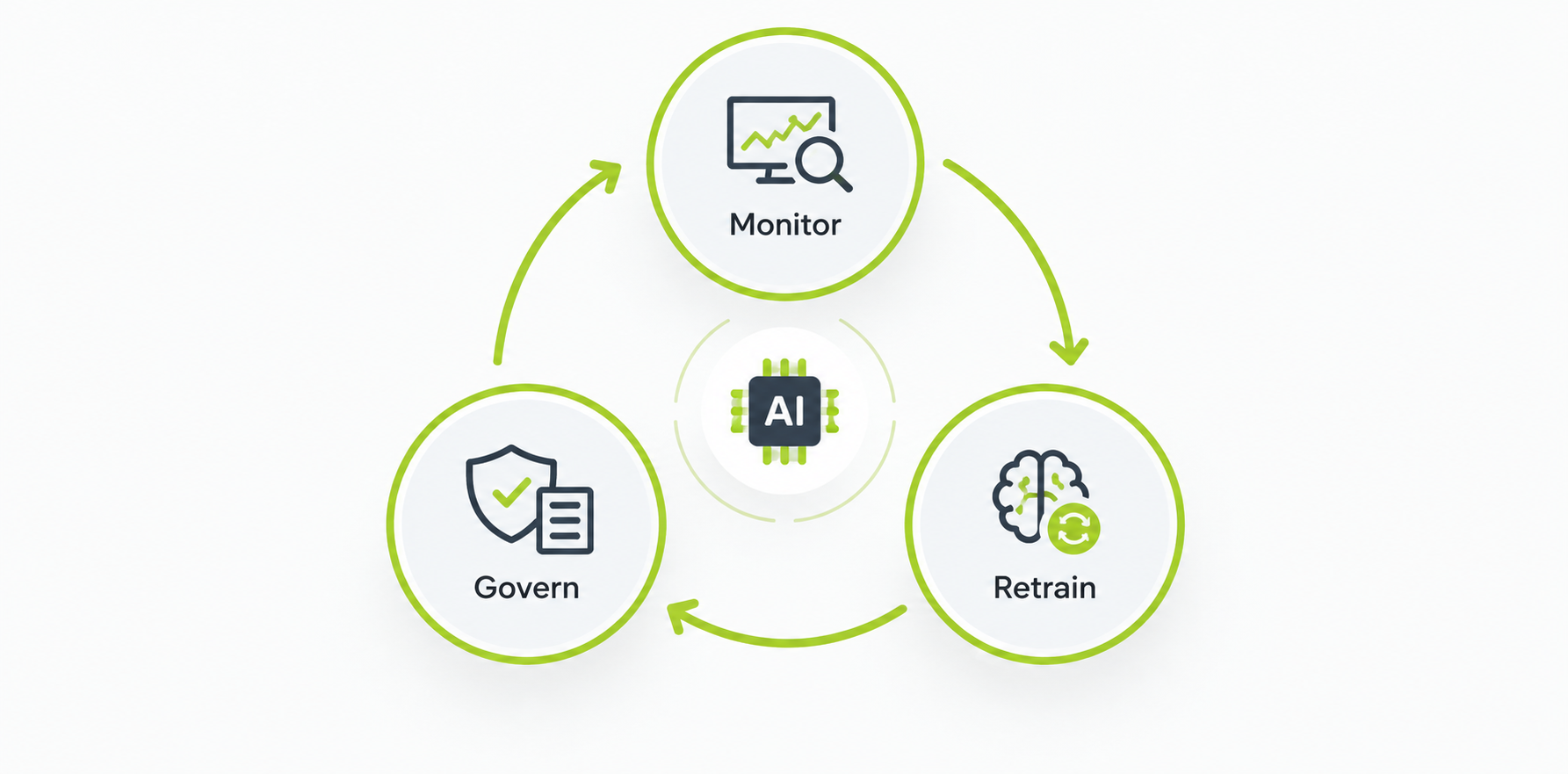
The AI model development process does not end at launch. Track accuracy, input drift, latency, cost and user feedback. A common drift check is the population stability index, where a score above roughly 0.25 signals a major shift worth investigating. Schedule retraining, keep a rollback option, and log who approved each version.
How to Develop Custom Generative AI Models
To develop custom generative AI models, the process is the same nine steps with four changes.
- Start with retrieval. Ground answers in your documents so they are current and traceable. Add fine-tuning later only if tone, format or domain language still falls short.
- Build an evaluation set first. Collect 100 to 300 real questions with approved answers before you build anything. Without it you cannot tell whether a change helped.
- Measure groundedness, not just fluency. Score whether each answer is supported by the retrieved sources, how often the model refuses correctly, and how often it makes things up.
- Add guardrails. Limit what the system can access, filter sensitive outputs, and route low-confidence answers to a person.
Teams that develop custom generative AI models this way usually ship a useful first version in weeks, then improve it from real usage logs.
How Much Does Custom AI Development Cost?
There is no single price, but the drivers are consistent. In order of impact:
- Data readiness. Scattered, unlabeled data can make preparation cost more than modeling.
- Approach. Custom AI models get more expensive at each rung of the decision ladder.
- Accuracy target. The last few points of accuracy are the most expensive.
- Integration depth. A dashboard is cheap. A model wired into checkout or claims processing is not.
- Run cost. One published planning guide puts first-year running costs at 20 to 35 percent of the build cost, covering evaluation, monitoring, updates, hosting and inference.
For budgeting, use these planning bands from published guides: a production RAG system commonly lands between $25K and $60K, a mid-complexity fine-tuned model between $40K and $120K, and a custom model trained on proprietary data between $50K and $200K. Classic prediction models on clean, structured data, such as churn or demand forecasts, often sit at the lower end. Vendor figures vary, so get a paid data audit before you accept any fixed quote.
Tools and Platforms for AI Model Development
You rarely start from an empty repository. Most AI model development today sits on top of an existing platform, so choose tools based on where your data already lives.
| Layer | Common options | Use it for |
| Cloud ML platforms | Amazon SageMaker, Google Vertex AI, Azure Machine Learning, Databricks | Training, deployment and monitoring in one place |
| Foundation models | Models from Anthropic, OpenAI and Google; open-weight models such as Llama and Mistral | Language, vision and generative tasks |
| Model hubs and frameworks | Hugging Face, PyTorch, TensorFlow, scikit-learn, XGBoost | Fine-tuning, self-hosting and classic prediction |
| Experiment tracking and MLOps | MLflow, Weights & Biases, Kubeflow | Versioning, reproducibility and pipelines |
| Retrieval and vector storage | pgvector, Pinecone, Weaviate | Searching your documents for RAG |
Building Your Own AI Model In-House or With a Partner
Whether you are building an AI model for one team or the whole company, building your own AI model in-house gives you control and keeps knowledge on your team, but you need data engineers, ML engineers, a product owner and someone who owns security and compliance. If you do not have these roles, a partner gets you moving faster, and a hybrid works well: the partner builds the first version while your team learns the stack.
Choose in-house when AI is core to your product, when you already have a data platform and ML talent, or when data cannot leave your environment. Choose a partner when you need a first result in months, lack specialist skills, or want an outside view on feasibility.
BOSC Tech Labs works with SMB and mid-market teams to build and deploy production AI systems, from model development to deployment.
How to Choose a Custom AI Development Company
Searching for a custom AI development company returns long lists of agencies that all sound alike. Use a scorecard instead. Score each candidate from 1 to 5 on the criteria below, and weight the ones that matter most to you.
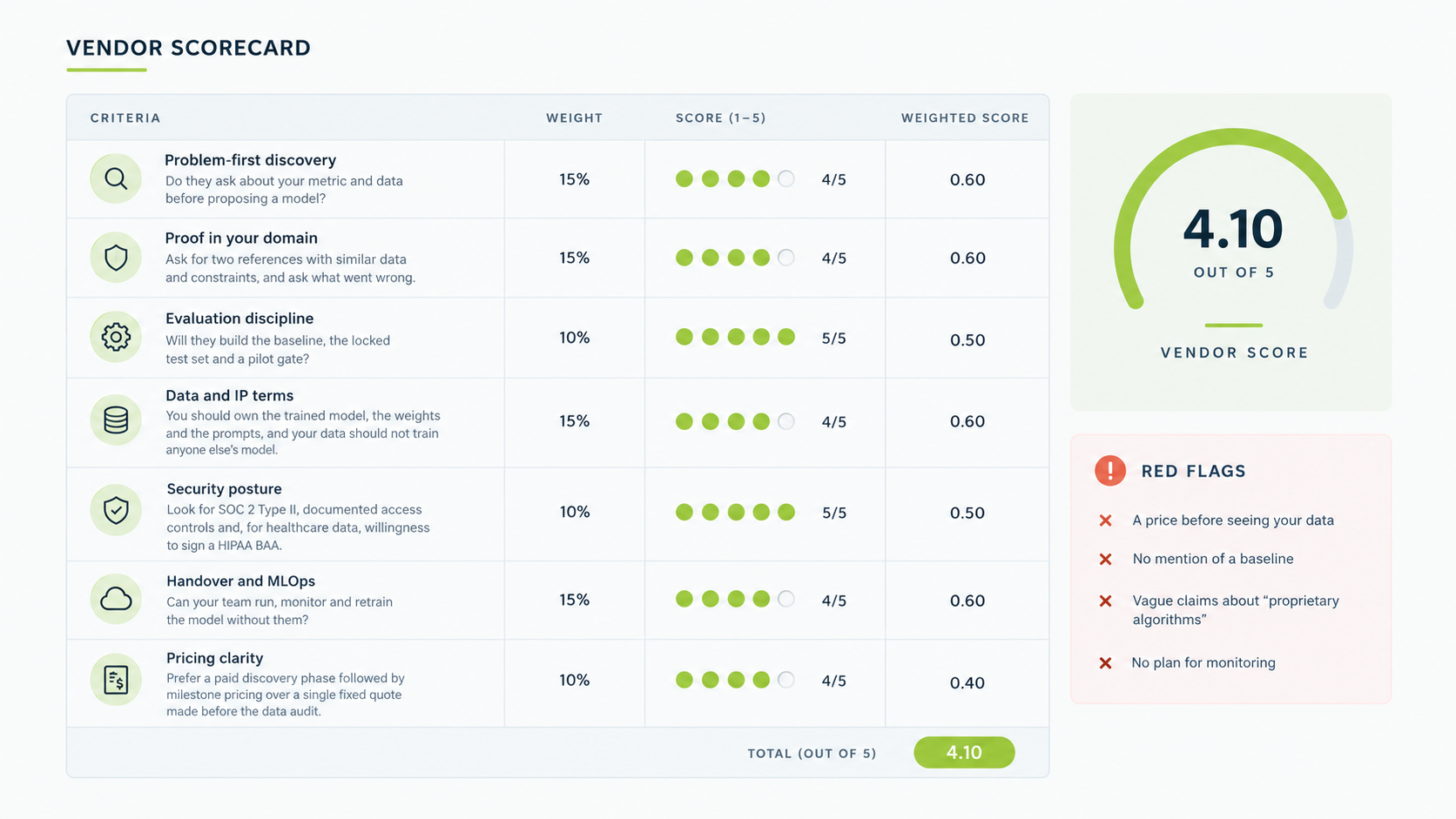
- Problem-first discovery. Do they ask about your metric and data before proposing a model?
- Proof in your domain. Ask for two references with similar data and constraints, and ask what went wrong.
- Evaluation discipline. Will they build the baseline, the locked test set and a pilot gate?
- Data and IP terms. You should own the trained model, the weights and the prompts, and your data should not train anyone else’s model.
- Security posture. Look for SOC 2 Type II, documented access controls and, for healthcare data, willingness to sign a HIPAA business associate agreement.
- Handover and MLOps. Can your team run, monitor and retrain the model without them?
- Pricing clarity. Prefer a paid discovery phase followed by milestone pricing over a single fixed quote made before the data audit.
Red flags: a price before seeing your data, no mention of a baseline, vague claims about “proprietary algorithms,” and no plan for monitoring.
Custom AI Development Company in USA: What to Check
A US-based partner often adds practical benefits: overlapping working hours, contracts under US law, and familiarity with HIPAA, SOC 2 and the NIST AI Risk Management Framework. Ask where data is stored and processed, whether any work is subcontracted offshore, and who is accountable if something breaks. Location is not a quality signal on its own, so apply the same scorecard.
What custom AI development services should include
Strong custom AI development services cover discovery, data engineering, model development, integration, evaluation, deployment and a monitoring plan. When comparing custom AI development services, be cautious of offers that cover only the model, because that is the easiest part to hand over and the least likely to deliver value alone.
Why Custom AI Projects Fail, and How to Avoid It
- No owner or metric. Fix it in step one.
- Data surprises. Fix it with a data audit before any quote.
- Skipping the baseline. Fix it by requiring one.
- Pilot purgatory. Fix it with a gate and a deadline.
- No plan for drift. Custom AI models degrade as data changes, so fix it with monitoring and a retraining schedule.
- Integration left to the end. Fix it by designing it in step two.
Security, Governance and Compliance
Custom AI models trained on sensitive data need governance built in, not paperwork added after launch. Use the NIST AI Risk Management Framework, and its Generative AI Profile for language systems, as a checklist for mapping and managing risk. ISO/IEC 42001 offers a certifiable management standard if customers ask for one. Minimum practices: anonymize sensitive fields, restrict access by role, keep audit logs, run bias checks on key segments, document intended use, and keep a human in the loop for high-stakes decisions. If you serve customers in the EU, confirm with counsel which EU AI Act obligations apply to your use case.
An Illustrative Example: Predicting Account Churn
The numbers below are hypothetical and show how the steps fit together.
A regional B2B distributor wants to find accounts likely to lapse. Step one sets the goal: flag the top 10 percent of at-risk accounts so account managers can call them. A data audit finds three years of order history but inconsistent customer IDs, which take three weeks to fix. A logistic regression baseline reaches an ROC-AUC of 0.71. A gradient-boosted model reaches 0.82 on the locked test set. A 60-day shadow pilot shows flagged accounts churn at twice the rate of unflagged ones, so the team deploys it to the CRM and sets a monthly drift check. Notice that no step needed a large language model.
Frequently Asked Questions
How to create an AI model for my business?
To learn how to create an AI model that pays off, follow the nine steps above: define one problem and metric, audit your data, build a simple baseline, choose an approach, train and evaluate on a locked test set, pilot it, then deploy and monitor. Start small and prove value before you scale.
How to develop an AI model without a large data science team?
If you want to know how to develop an AI model with a small team, start with the decision ladder. Prompting and RAG on a hosted foundation model need engineers and domain experts rather than researchers. Use a partner for the first version and plan the handover early.
How long does custom AI model development take?
Roughly 2 to 6 weeks for prompting or RAG, and 6 to 20 weeks for fine-tuning or a custom predictive model, plus data preparation. The pilot, not the finished system, is the honest milestone to plan around.
How much data do I need?
It depends on the approach. RAG needs good documents rather than large datasets, and fine-tuning can work with hundreds to thousands of high-quality examples. Classic prediction models need enough history to cover seasons and edge cases. Quality, labeling and representativeness matter more than volume.
Should I build or buy?
Buy when your process is standard and an existing tool meets your metric. Build or customize when your data is a competitive asset, when compliance limits where data can go, or when errors are costly. Many companies do both.
What is the difference between a custom AI model and an AI agent?
A model produces a prediction or generated output. An agent uses one or more models to take actions, such as calling tools or updating records. If you need a forecast, you need a model. If you need something to act on the forecast, you need an agent built around it.
What should I look for in a custom AI development company in USA?
Look for problem-first discovery, domain references, evaluation discipline, clear IP terms, a documented security posture such as SOC 2, and a handover plan. Ask where data is processed and who has access.
Conclusion: Start Small, Prove Value, Then Scale
Successful custom AI model development is less about picking the fanciest algorithm and more about discipline. Building an AI model that lasts comes down to this: one clear problem, honest data, a baseline to beat, a pilot with a gate, and a plan to monitor what you ship. Climb the decision ladder only as far as you must, and treat the first project as the foundation for the next. Once you know how to build an AI model once, the second and third get faster.
Next step: Not sure which rung fits your use case? Request a data readiness review and get a scoped plan, a realistic budget band and a go or no-go recommendation before you commit.