An AI medical receptionist answers patient calls, books and moves appointments and sends reminders 24/7, so no caller reaches voicemail. Here are the 7 reasons clinics use one, plus costs and HIPAA checks.
A patient who calls at 7:45 PM on a Friday should be able to book, not leave a voicemail you hear on Monday. Closing that gap is why more practices now look at an AI receptionist for clinics.
At BOSC Tech Labs, we build voice AI for healthcare teams, including Auralie, a 24/7 patient call assistant for a healthcare provider in Australia. This guide draws on what that project taught us.
This guide is for clinic owners and practice managers. To see what a production system looks like, explore our AI reception assistants.
Key takeaways:
- It answers calls 24/7, books into your calendar and sends reminders by voice, SMS or email.
- It handles routine requests and passes urgent or clinical calls straight to your staff.
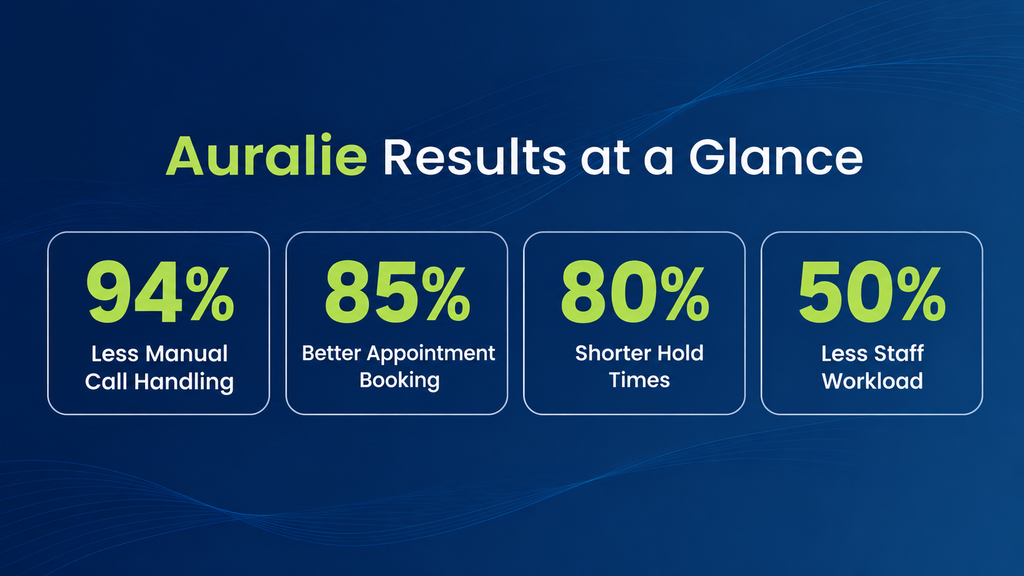
- Our clinic voice AI project cut manual call handling by 94% and patient hold times by 80%.
- Before you buy, ask for a signed business associate agreement and proof of encryption.
What is an AI medical receptionist?
An AI medical receptionist is software that answers clinic calls and messages in natural speech, books appointments in your calendar and hands complex or urgent calls to your staff.
It works like a trained front-desk colleague who never goes home. Speech recognition turns the caller’s words into text, and a language model works out what the caller wants.
It then acts inside the tools you already use, such as your calendar and practice management software, so new bookings appear exactly where your staff expect them.
It is not a clinician. A well-built medical AI receptionist does not diagnose or give medical advice, and it follows the rules your clinic sets for every type of call.
How a virtual medical receptionist handles a call
Every call runs through the same five stages. The call is answered, the request is understood and clinic rules are checked. Then a slot is booked and a reminder goes out by SMS, voice or email.
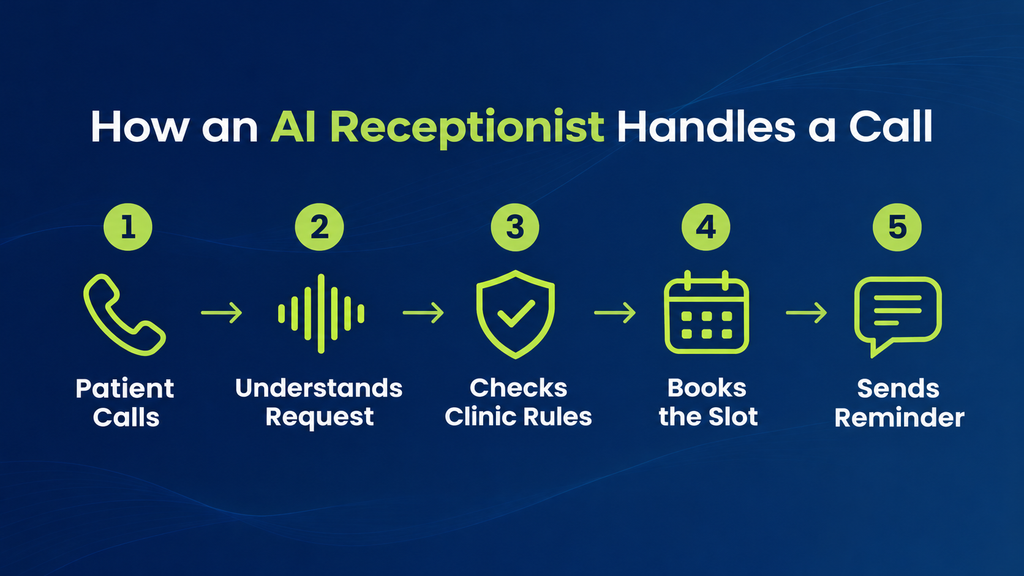
If any stage fails, for example the caller sounds distressed or asks something outside the rules, the call moves to a person straight away, with the details already captured.
What does an AI receptionist for clinics handle?
An AI medical receptionist handles the routine, rule-based calls and messages that fill most of a front desk’s day. Your team then spends that time with patients in the clinic.
Typical tasks include:
- Booking, rescheduling and cancelling appointments in real time, without double bookings.
- Sending reminders and confirmations by voice, SMS or email.
- Answering questions about opening hours, services, parking and directions.
- Collecting intake details and insurance information before the visit.
- Taking after-hours messages and routing them to the right person.
It should not handle everything. Clinical questions, test results and anything that sounds like an emergency belong with your staff, and a good setup passes those calls on at once.
A simple test helps: if a trained new hire could answer the call from a script on day one, an AI phone agent for clinics can usually answer it too.
7 reasons your clinic needs an AI medical receptionist
The strongest reasons are 24/7 access, predictable costs, fewer no-shows, shorter hold times, consistent answers, secure records and easy growth. Here is what each one means in practice.
1. Patients can reach you 24/7
An AI medical receptionist never goes off shift. The Friday-evening caller can book, reschedule or get directions straight away instead of waiting until Monday.
That matters most for new patients, who often call the next clinic on their list when nobody answers.
2. Front-desk costs stay predictable
A full-time front-desk receptionist in the US can cost $40,000 to $60,000 a year in salary and benefits. An AI front-desk assistant takes routine calls for a fixed fee, so busy days no longer mean overtime.
It does not remove the need for staff. It lets the people you already have spend their hours on patients rather than on the phone.
3. Fewer no-shows with automatic reminders
Automatic reminders, plus an easy way to reschedule by reply or call, lower your no-show rate because patients cancel early instead of simply not turning up.
The freed slot can then go to someone on your waiting list, who can be contacted the same day.
4. Shorter hold times and no missed calls
An AI phone agent for clinics can answer many calls at once, so patients stop hearing hold music at 9 AM on a Monday. Calls that need a person reach staff who are no longer stuck on bookings.
When we launched Auralie, manual call handling fell by 94% and patient hold times dropped by 80%. Staff workload halved, and appointment booking improved by 85%.
Here is how the clinic’s front desk changed before and after launch:
| Area | Before | After |
|---|---|---|
| Call handling | Long waits and missed calls | No missed inquiries, faster handling |
| Scheduling | Manual entry and double bookings | Real-time booking with conflict checks |
| Reminders | Manual updates and mismatches | Automatic, synced with schedule changes |
| Staff workload | Peak-hour overload | About half the routine work |
The clinic’s operations team summed it up simply: staff got their time back for the patients in front of them.
You can read the full clinic case study for the setup and architecture.
5. Consistent, multilingual patient conversations
Every caller hears the same polite, accurate answers, even at peak hours. Patients can also talk in the language they prefer, which matters in clinics that serve mixed communities.
6. Secure, auditable handling of patient data
A well-built virtual medical receptionist encrypts calls and records and logs every action, so you can see who accessed what and when. The HIPAA section below covers what to check.
7. It scales as you add locations
Adding a second or third site does not mean hiring a new phone team. One AI front-desk assistant can apply each location’s hours and rules and keep bookings in sync across clinics.
AI receptionist vs human receptionist vs answering service
An AI system handles volume and after-hours calls, a human receptionist handles judgement and empathy, and a medical answering service mostly takes messages rather than booking visits.
Here is how the three options compare for a typical clinic:
| AI receptionist | Human receptionist | Answering service | |
|---|---|---|---|
| Hours | 24/7 | Office hours | 24/7 or after hours |
| Books appointments | Yes, into your calendar | Yes | Usually takes messages |
| Calls at once | Many | One | A few per agent |
| Best for | Routine, high-volume calls | Complex and sensitive calls | Overflow and messages |
| Cost model | Subscription or build fee | Salary and benefits | Per minute or per call |
Most clinics get the best result from a mix: an AI medical receptionist for routine and after-hours calls, and people for complex, sensitive or in-person moments.
An answering service can still work as overflow, but unlike an AI receptionist for medical practices, it rarely updates your calendar, so staff redo the booking the next morning.
How much does an AI receptionist cost?
Most clinics pay a yearly subscription for a ready-made tool or a one-time fee for a custom build. Your AI receptionist cost depends on call volume, languages and the systems it must update.
As of late 2026, these are typical ranges for a US clinic:
| Option | Typical cost | Best for |
|---|---|---|
| Off-the-shelf subscription | About $5,000 to $10,000 a year | One clinic with standard calls |
| Custom-built assistant | About $25,000 to $60,000 to build, plus hosting | Multi-site groups, custom workflows, deep system links |
| Full-time receptionist (US) | About $40,000 to $60,000 a year with benefits | Comparison baseline |
A subscription is usually enough for one clinic with standard calls. A custom AI medical receptionist pays off for multi-site groups or clinics with unusual workflows and deep system links.
When clinics ask us for a quote, we first map their top call types and every system the assistant must update. Those two answers drive most of the build effort and the final price.
Other price drivers are extra languages, compliance reviews and hosting. If you need a tailored build, our custom AI agent development team can scope it with you.
Is an AI medical receptionist HIPAA compliant?
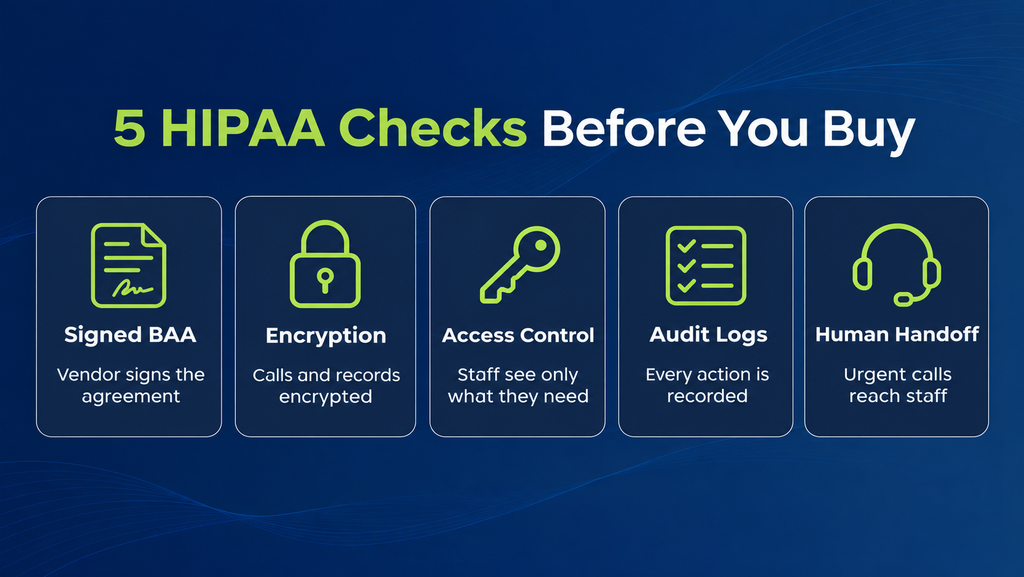
Yes, if it is set up correctly. The vendor must sign a business associate agreement, encrypt calls and records, limit staff access by role and keep a log of every action.
The US Department of Health and Human Services (HHS) is clear on this. A vendor that creates, receives, stores or sends patient health information for you needs a signed agreement, even for encrypted data.
Before you choose a HIPAA compliant AI receptionist, confirm these five points in writing:
- A signed business associate agreement that covers call recordings and transcripts.
- Encryption of calls and records, both in transit and at rest.
- Role-based access, so each staff member sees only what they need.
- Audit logs that record every booking, change and data access.
- A clear handoff to a person for urgent or clinical calls.
On our clinic voice AI project, we built encryption and role-based access into the call pipeline from day one instead of adding controls after launch. Retrofitting security later is slower and riskier.
Ask each vendor exactly what its agreement covers, because some cover the phone service but not the AI model or storage behind it. If you are unsure, ask a healthcare lawyer to review the contract.
How to roll out an AI receptionist in 5 steps
Start small: launch with one or two high-volume call types, prove they work, then add more. A phased rollout keeps staff confident and gives patients time to get used to the change.
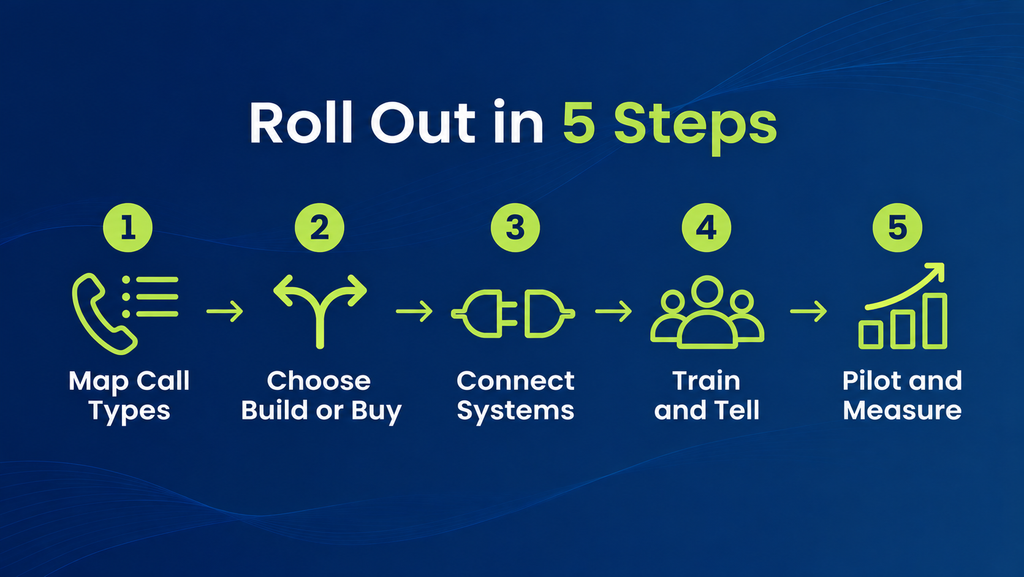
- Map your call types. List your ten most common calls and the words that signal an urgent one.
- Choose build or buy. Compare a subscription with a custom build, and confirm you are getting a HIPAA compliant AI receptionist before you sign.
- Connect your systems. Link the calendar, EHR and phone line so bookings land in one place; our AI integration services team handles this for clinics.
- Tell staff and patients. Explain what changes, train the team and give patients a one-step way to reach a person.
Before building anything, our team sat with clinic staff to hear how patients really speak on calls. Staff were worried about their roles, so involving them early mattered as much as the tech.
- Run a pilot and measure. Track missed calls, hold time and your no-show rate for four to six weeks before you expand.
Older and less tech-savvy patients adapt faster when a virtual medical receptionist speaks clearly and offers a person at any point in the call.
Treat your AI medical receptionist as a team member with a defined job, not as a replacement for your front desk.
Frequently asked questions
Can an AI receptionist replace a human receptionist?
No. It takes over routine calls so your staff can focus on patients in the clinic and on complex or sensitive calls. Most clinics run both, with the AI covering volume and after-hours demand.
How long does it take to set up an AI receptionist in a clinic?
Subscription tools can go live within days. A custom build usually takes 6 to 12 weeks, including connecting your calendar and EHR, testing call flows and running a short pilot with real patients.
What happens if a patient calls with an emergency?
It is set up to spot urgent words and pass the call to staff at once, or to tell the caller to hang up and dial 911. It never gives medical advice or tries to judge how serious a symptom is.
Can an AI receptionist speak more than one language?
Yes. Most modern systems understand and reply in several languages and handle different accents. Test it with real recordings from your own patients before launch, especially in noisy settings.
Does an AI receptionist work with my existing EHR and phone system?
Usually, yes. It connects through your EHR or practice management software scheduling interface and keeps your current phone number. Confirm the vendor supports your exact system before you sign.
Will older patients be comfortable talking to an AI receptionist?
Many are, if it speaks clearly, lets them interrupt and offers a person at any point. Tell patients about the change in advance, by letter or at the desk, so the first call is not a surprise.
Final word: start with your busiest call type
An AI medical receptionist pays off fastest when it takes over the calls that swamp your front desk today, usually bookings, reminders and opening-hours questions.
Pick that one call type, run a short pilot and measure missed calls and hold times. A well-scoped AI receptionist for clinics gives patients faster answers and gives your staff time back.
Want help choosing what to automate first? Explore our healthcare software solutions and book a free consultation to map your clinic’s calls.