Subscriber churn prediction uses reader data to spot who is likely to cancel before they do. For one news publisher, pairing it with action-picking AI cut monthly churn from 8% to 5% in six months.
BOSC Tech Labs builds AI, data and media app systems for publishers and SaaS teams. This case study walks through a churn project we delivered for a subscription news publisher, from raw data to live retention actions.
The client was a subscription news publisher founded in 2015, covering politics, policy, finance, sports, technology and entertainment. Free news apps, social feeds and podcasts were pulling its paying readers away.
Below we show the data, the AI churn prediction set-up, the retention actions and the results. It is written for publishers weighing the same move, by the team behind our media app development services.
Key takeaways:
- Monthly churn fell from 8% to 5% within six months of launch.
- The model learned from 12 months of reader data and reached 89% accuracy.
- Each at-risk reader got an action matched to their likely reason for leaving.
- The full solution took about 3.5 months, from data to a trained team.
What is subscriber churn prediction, and why do publishers need it?
Subscriber churn prediction is a machine learning method that scores each paying reader’s chance of cancelling within a set window, such as 30 days, so teams can act before the cancellation happens.
Predictive analytics answers who is likely to leave. Prescriptive analytics answers what to do about each of them. A publisher needs both, because a risk list without an action plan only shows who you are about to lose.
News publishers feel churn sharply. Free headlines, social feeds and podcasts compete for the same attention, so paying readers drift away quietly, months before they finally cancel.
That slow drift is what makes predicting subscriber churn so valuable: the warning signs show up in behaviour long before a reader clicks cancel.
Keeping a reader is also cheaper than replacing one. Harvard Business Review reports that winning a new customer costs 5 to 25 times more than keeping an existing one.
You can see how this fits wider newsroom systems on our AI for media and publishing page.
The problem: 8% of subscribers leaving every month
The publisher was losing 8% of its subscribers every month, about $500,000 in revenue a year. Its only retention tool was a generic discount email, sent without knowing who was at risk or why.
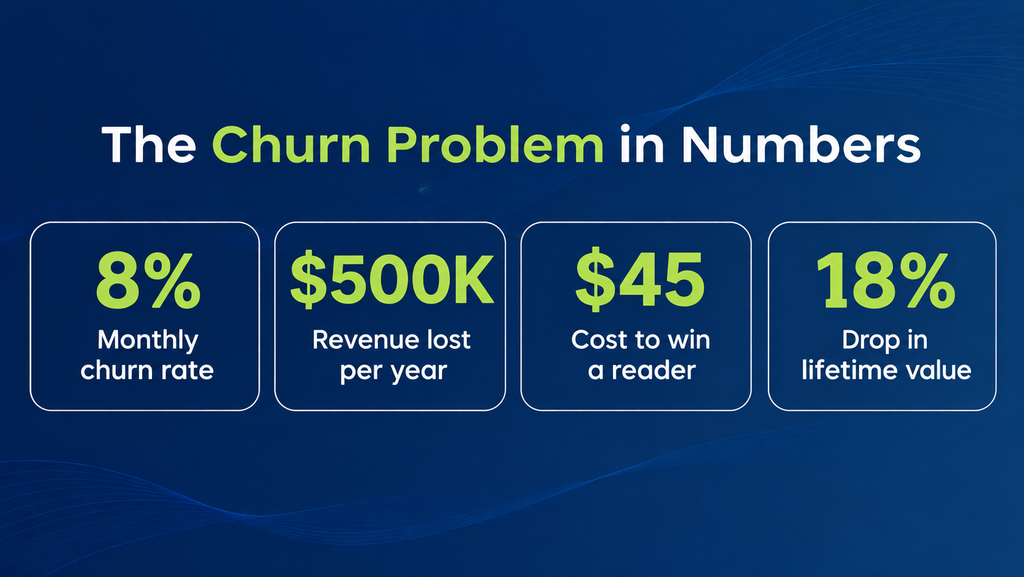
The table below sums up where the publisher stood before the project started.
| Metric | Before the project | What it meant |
|---|---|---|
| Monthly churn | 8% | About 1 in 12 subscribers lost every month |
| Revenue lost | About $500,000 a year | Retention became a leadership problem |
| Cost to acquire a reader | $45 | Replacing lost readers kept getting dearer |
| Customer lifetime value | Down 18% in two years | Each subscriber was worth less over time |
| Top reasons for leaving | Content fatigue 40%, pricing 30% | Two fixable causes behind most cancellations |
Most of the loss traced back to two causes the publisher could actually change.
Content fatigue drove 40% of cancellations and pricing concerns another 30%. Readers wanted news on their own interests, and many no longer saw enough value to keep paying.
Subscribers were also opening fewer articles each month, and some stopped clicking at all. One content plan for everyone was not working, and the team needed a way to reduce subscriber churn before readers hit cancel.
How predictive AI flags at-risk readers
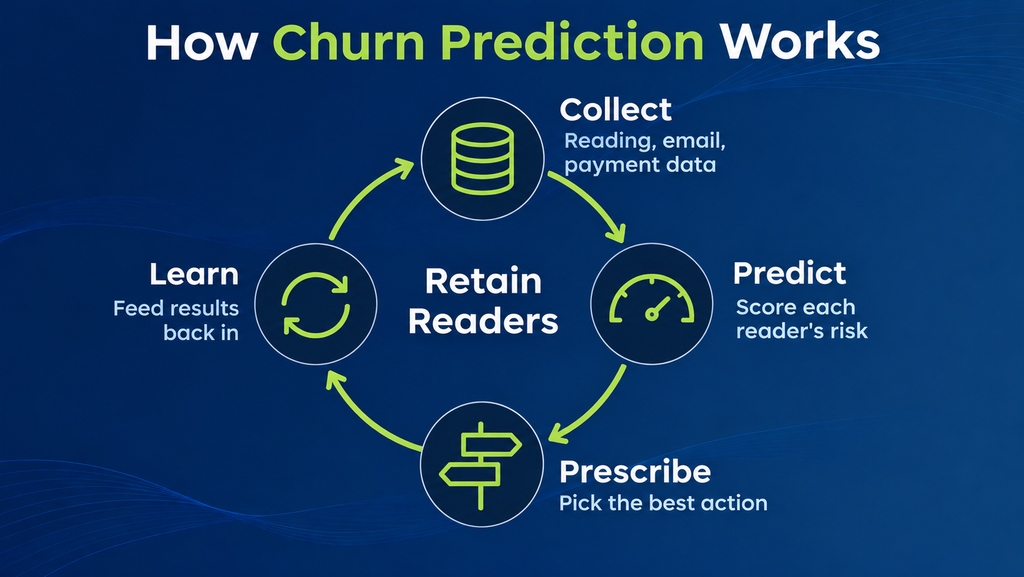
Predictive AI scores every subscriber on how likely they are to cancel, based on their recent behaviour. Readers above a set risk level are flagged early, while there is still time to win them back.
What data does AI churn prediction use?
The model looks for changes in behaviour rather than single events. These were the main signals in this project:
- Reading frequency and the sections a reader opens
- Newsletter open rates
- How often the reader logs in
- Payment history and renewal dates
- Support tickets and survey answers
- Profile updates, age and location
When we pulled 12 months of reader data together, a quarter of the profiles were incomplete. We fixed validation first, because a churn score built on gaps only flags the wrong readers faster.
Bringing these sources into one clean place is usually the longest job, and it is the same groundwork as building AI-ready data pipelines.
How a risk score becomes an alert
The churn prediction model gives each reader a risk score and the likely reason behind it. When a score crosses the threshold, that reader lands on the team’s risk list before they cancel.
This is what makes AI churn prediction useful in practice: thousands of quiet signals become one short daily list the team can work through.
Subscriber churn prediction on its own ends with that list. The next step decides what each flagged reader should actually receive.
How prescriptive AI picks the right retention action
Prescriptive AI takes each at-risk reader’s score and likely reason for leaving, then recommends the action most likely to keep them, such as content picks, a pricing offer or a personal call.
Here is how the main warning signs mapped to actions in this project.
| Signal the model sees | Likely reason | Recommended action |
|---|---|---|
| Reads fewer sections, skips usual topics | Content fatigue | Personalised topic feed or newsletter |
| Visits pricing page, considers downgrading | Price sensitivity | Limited-time offer or niche plan |
| No login for several weeks | Disengagement | Re-engagement email campaign |
| High-value reader with support complaints | Service problem | Direct outreach from the team |
The pattern is simple: the action follows the reason, so a bored reader gets better content, not a discount.
Generic discount emails were the publisher’s main retention tool before this project. We replaced them with actions matched to each reader’s likely reason for leaving, from content picks to pricing offers.
Not every at-risk reader can be saved. Uplift modelling targets the persuadable ones, so offers are not wasted on readers who would leave or stay anyway.
The recommendations also reach wider business choices, such as new subscription tiers, niche news packages and time-limited offers for groups with the same reason for leaving.
Paired this way, subscriber churn prediction stops being a report and becomes a working to-do list for the retention team.
How we built it: 5 steps in 3.5 months
We delivered the subscriber churn prediction solution in about 3.5 months, from first data audit to a trained client team. The work ran in five steps, each with an output the publisher could check.
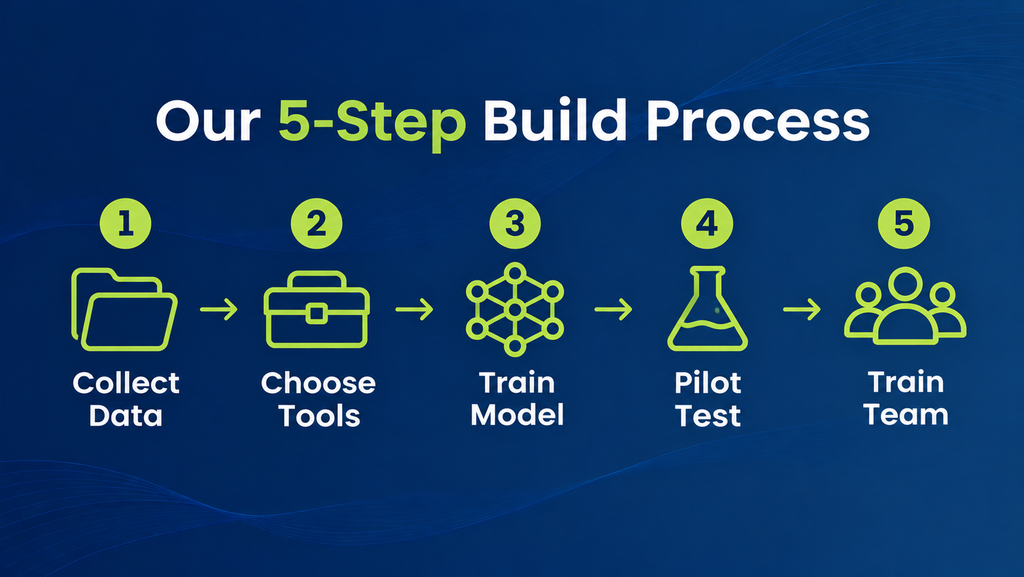
- Collect data: we brought together 12 months of reading data, support tickets, payment history, profile updates and survey responses.
- Choose tools: we trained machine learning models on that history and used large language models to process text such as tickets and survey answers.
- Train the model: 80% of the data trained the churn prediction model and 20% tested it. After three to four rounds, it reached 89% accuracy.
- Pilot test: we ran the system on 10,000 high-risk subscribers and cut churn among them by 18%, then refined the predictions and recommendations.
- Train the team: we handed over the risk dashboards with hands-on training for the staff who would use them every day.
We did not hand over a dashboard and leave. Our experts ran a two-week workshop so the publisher’s team could read risk scores and act on them inside their daily workflow.
Accuracy is only one measure. If you are comparing vendors, also ask for precision and recall, which show how many flagged readers were truly at risk and how many real leavers were caught.
For a closer look at this kind of model work, see how custom AI models are built.
Results after six months
Six months after launch, monthly churn fell from 8% to 5% and retention rose 15%. Subscriber churn prediction also lifted renewals by 20% and saved about $300,000 a year.
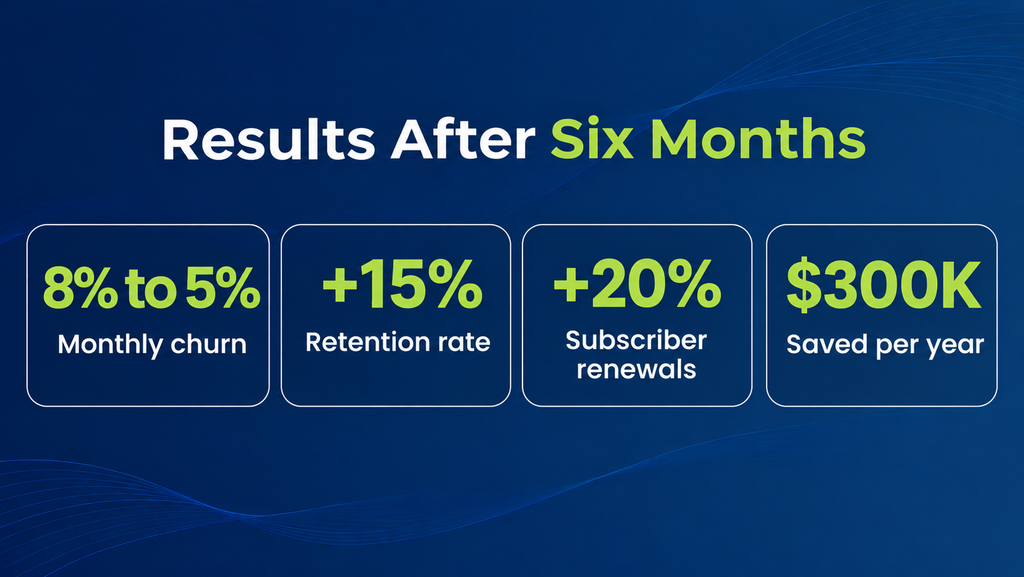
The table compares the main numbers before launch and six months after it.
| Metric | Before | After six months |
|---|---|---|
| Monthly churn | 8% | 5% |
| Retention rate | Baseline | +15% |
| Subscriber renewals | Baseline | +20% |
| High-risk readers re-engaged | – | 20% |
| Manual retention work | Baseline | −30% |
| Annual saving | – | About $300,000 |
The biggest change was the churn rate itself: three fewer subscribers lost per hundred, every month.
The renewal lift matters as much as the churn drop, because renewal time is when annual subscribers decide whether the product is still worth paying for.
That is the case for churn prediction for publishers: small monthly gains in retention compound into a much larger paying audience over a year.
Automation changed daily work too. With manual retention tasks down by 30%, the team spent its time on high-value readers instead of sending blanket discount emails.
The results stay visible in a live dashboard, the kind of reporting we build through our analytics dashboard development work.
Challenges we solved along the way
Four problems came up during the build, and each needed a fix before the publisher’s team could trust the system: incomplete data, staff doubt, privacy risk and false alarms.
| Challenge | What we saw | How we fixed it |
|---|---|---|
| Data quality | 25% of profiles incomplete | Automated validation and enrichment tools |
| Staff trust | 40% of staff doubted the AI | “AI Champions” programme with hands-on training |
| Privacy | Risk in personalised campaigns | Double opt-ins and anonymised processing |
| False alarms | 22% false positives at first in the subscriber churn model | Added social sentiment signals to the training data |
None of these were technical dead ends; each was solved with process as much as code.
Before launch, 40% of the publisher’s staff doubted the AI’s advice. Our AI Champions programme gave them hands-on training, and we put double opt-ins in front of every personalised campaign for GDPR.
Is subscriber churn prediction right for your business?
Churn prediction for subscribers suits businesses with at least a year of customer history and enough subscribers to learn patterns from. You also need people ready to act on what the model flags.
Check these four points before you start:
- At least 12 months of behaviour, payment and support data
- A clear definition of churn, such as cancellation or non-renewal
- A team that can act on alerts every week
- Consent to personalise offers and emails
The same approach works in SaaS, e-commerce, retail and streaming, anywhere repeat customers are central to your customer retention strategy.
Frequently asked questions
How much data do you need for subscriber churn prediction?
Most projects start with at least 12 months of history, as this one did. You need behaviour, payment and support data for the same readers, so seasonal patterns and renewal cycles show up clearly.
How does prescriptive analytics reduce churn beyond prediction?
Prediction tells you who may leave; prescriptive AI compares possible actions and picks the one most likely to keep each reader. That stops teams from sending the same discount to everyone at risk.
Which algorithms work best for predicting churn?
Tree-based models such as gradient boosting, along with logistic regression, are common starting points. The best choice depends on your data, so teams usually test several on a held-out sample first.
Can a small publisher do this without a data science team?
Yes, if you have clean subscription data and someone to act on alerts. A partner can build the model and connect alerts to your CRM or email tool, so your team works from a simple daily list.
Is churn modelling compliant with GDPR?
It can be, if personal data is processed lawfully and with consent. This project used double opt-ins and anonymised processing for personalised campaigns; confirm your own setup with a privacy professional.
How do you know a retention offer actually worked?
Compare readers who got the offer with a similar group who did not. Only the gap between the two groups shows real impact, and uplift modelling uses the same idea to decide who to target.
The takeaway: act on churn signals early
The lesson from this project is simple: spot churn signals early and match each action to the reason a reader is leaving. Done well, subscriber churn prediction turns a vague worry into a weekly plan.
If you want to reduce subscriber churn in your own product, talk to our AI consulting team about your data and goals.
Start with the data you already have, define what churn means for your product, and test actions on a small group before rolling them out.