


Sports training has always depended heavily on observation. A coach watches an athlete move, identifies a technical issue, explains the correction, and then watches again to see whether the athlete improves.
That approach still matters. But as training programs grow, coaches are expected to review more footage, support more athletes, provide personalized feedback, and demonstrate measurable progress.
This is where computer vision is changing the training process.
Instead of treating video as something coaches simply watch, computer vision can turn training footage into structured performance data. It can help identify movements, organize clips, analyze technique, surface important moments, and create a consistent record of player development.
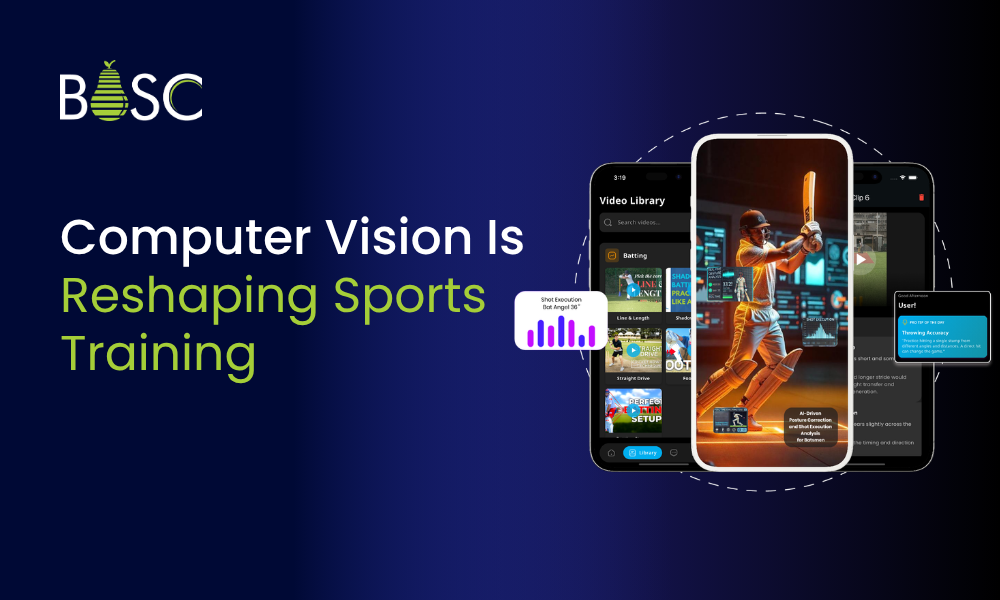
The CricVision project demonstrates how this approach can work in a real cricket coaching environment. Built by BOSC Tech Labs, CricVision combines video capture, automated organization, cricket-specific computer vision, performance insights, personalized drills, dashboards, and communication into one workflow.
What Is Computer Vision in Sports Training?
Computer vision is a branch of artificial intelligence that enables software to interpret information from images and video.
In sports, that means video can become more than recorded footage. A computer vision system can be designed to identify players, movements, events, positions, and other visual patterns relevant to a particular sport.
For a training platform, the process can look like this:
Video capture → Video organization → Vision analysis → Performance insights → Coaching action → Progress tracking
The objective is not to replace the coach.
Instead, computer vision can reduce the manual work involved in reviewing footage and give coaches more structured information to support their decisions.
That distinction was central to the CricVision project. BOSC Tech Labs approached the system as an AI coaching partner designed to support coaching judgment rather than replace it.
Why Traditional Video-Based Training Becomes Difficult to Scale
Video has already become an important part of sports training. Coaches can record sessions, review technique, create clips, and show athletes what they need to improve.
The problem is what happens after the recording.
In the CricVision case study, manual video review was slow, repetitive, and difficult to scale. Coaches also faced challenges delivering personalized feedback when many players needed attention at the same time.
The quality of the footage itself created another problem. Different camera angles, lighting conditions, player distances, and shaky cameras could make analysis less reliable.
There was also no consistent baseline for tracking long-term development.
A coach might know that a player looked better this week, but turning that observation into structured evidence across multiple sessions is considerably harder.
This creates a fundamental problem:
The amount of available video can grow faster than the coach’s ability to analyze it.
Computer vision helps address this gap by automating parts of the video-to-insight workflow.
How Computer Vision Changes the Sports Training Workflow
The biggest change is not simply that AI can analyze video. The larger opportunity is connecting video analysis with the rest of the coaching workflow.
1. Turning Raw Footage Into Structured Data
A training video contains a large amount of visual information, but raw footage is difficult to search and analyze manually.
CricVision was designed to automatically upload, trim, and organize footage by player and drill.
This means coaches do not have to repeatedly search through long recordings to locate relevant moments.
Once footage is structured, computer vision can operate on specific clips rather than treating the entire video as an unorganized file.
This creates a foundation for more efficient performance analysis.
2. Analyzing Technique Frame by Frame
One of the important capabilities in the CricVision system is cricket-specific computer vision analysis.
The system uses a custom model trained for cricket biomechanics to analyze elements such as stance, stride, bat swing, and follow-through.
Rather than relying only on a coach watching the complete movement, the system can examine visual information frame by frame and measure aspects of posture, alignment, and motion.
This is particularly valuable in sports where small technical differences can affect performance.
For example, a coach may already recognize that a player’s movement needs correction. A computer vision system can help organize the visual evidence around that observation and make it easier to review consistently.
3. Finding the Clips That Matter
Another major advantage is automated clipping.
Instead of spending significant time scrubbing through full training sessions, coaches can receive relevant clips and highlight reels generated from the analyzed footage.
This changes the coach’s role from manually searching for every important moment to reviewing a more focused set of moments.
The result is not simply less video. It is more usable video.
4. Creating Personalized Training Recommendations
Computer vision becomes more useful when its output connects to coaching decisions.
In CricVision, a recommendation engine considers technique patterns, recent sessions, and player roles to suggest targeted drills.
This creates a feedback loop:
Observe → Analyze → Identify a pattern → Recommend a drill → Train → Record again → Measure progress
The value comes from connecting these stages rather than treating video analysis as an isolated feature.
5. Making Player Progress More Visible
One of the recurring challenges in sports development is demonstrating improvement over time.
A single training session provides limited context. Coaches need to understand how performance changes across weeks and training cycles.
CricVision addresses this through structured dashboards containing technique scores, weekly snapshots, growth charts, and trend lines.
This gives players and coaches a more consistent way to discuss development.
It also gives parents greater visibility into a player’s progress.
The CricVision case study identified parent expectations for measurable reports and transparency as part of the problem the system needed to solve.
Computer Vision Does Not Replace the Coach
There is an important distinction between automated analysis and automated coaching.
Computer vision can identify visual patterns and generate structured information. It does not automatically understand every contextual factor that influences an athlete’s performance.
A coach brings experience, tactical understanding, communication skills, knowledge of the athlete, and the ability to interpret what the data means in a particular training situation.
That is why the CricVision approach focused on building an AI coaching partner rather than replacing coaches.
The technology handles parts of the analysis workflow. The coach remains responsible for interpretation and coaching decisions.
This human-AI combination is particularly important in sports because performance is rarely determined by one isolated metric.
From Sports Video to a Complete Performance System
The next evolution of computer vision in sports is not simply better video analysis.
It is the integration of video, performance data, communication, and training workflows into a single system.
CricVision illustrates this architecture:
Capture: Coaches use phones or cameras they already have.
Auto-Organize: Footage is uploaded, trimmed, and organized by player and drill.
Vision Analysis: A cricket-trained model analyzes technique frame by frame.
Insights & Drills: Highlight reels, technique scores, and targeted drills are generated.
Track & Share: Dashboards and communication tools keep players, coaches, and parents aligned.
This workflow demonstrates why sports computer vision needs to be treated as a product engineering challenge rather than just a machine learning model.
The model is only one part of the system. Video ingestion, storage, processing, data organization, application workflows, dashboards, reliability, and user experience all need to work together.
Where Computer Vision Can Be Applied in Sports
Although CricVision focuses on cricket, the underlying concept can apply to other sports.
Computer vision systems can be designed for different sports and use cases, including:
- Athlete movement analysis
- Training-session video analysis
- Player tracking
- Event and action detection
- Performance review
- Tactical pattern recognition
- Automated video clipping
- Technique analysis
- Training data visualization
The exact capabilities depend on the sport, available footage, camera setup, data quality, and the specific performance questions the system needs to answer.
For organizations exploring these applications, BOSC Tech Labs provides computer vision development services that can turn video, imagery, and visual feeds into usable outputs inside real workflows.
The Engineering Challenge Behind Sports Computer Vision
Building a sports computer vision system is more complicated than connecting a camera to an AI model.
Real training environments are unpredictable.
Camera angles change. Lighting changes. Players move differently. Footage quality varies. Multiple athletes may appear in the same session. Processing requirements can increase as the number of teams, players, and sessions grows.
A production system therefore needs to account for:
- Video data organization
- Reliable processing pipelines
- Custom vision models
- Player and movement tracking
- Performance data structures
- Application and dashboard integration
- System validation
- Monitoring and reliability
- Scalability across teams and training environments
BOSC Tech Labs’ AI sports video analytics software development approach focuses on these broader engineering requirements, including video data organization, custom vision pipelines, player tracking, tactical pattern recognition, integration with performance tools, and validation under real operating conditions.
What the CricVision Case Study Shows
The CricVision provides a practical example of what happens when computer vision is connected to an actual coaching workflow.
The system was designed to address several operational problems at once.
Manual footage review became automated.
Long videos became structured player- and drill-specific clips.
Visual technique analysis became part of the training workflow.
Performance insights could be presented through dashboards.
Training recommendations could be connected to observed technique patterns.
Communication between coaches, players, and parents could happen within the same platform.
According to the case study, the resulting system increased coaching capacity, reduced manual review work, and provided more structured performance tracking.
The broader lesson is that the value of computer vision comes from what organizations do with the information extracted from video.
The Future of Sports Training Is More Data-Driven, Not Less Human
Computer vision is changing the role of video in sports.
Previously, video was primarily a recording that coaches watched. Increasingly, it can become a source of structured performance information that supports coaching decisions.
But the goal should not be to remove the human element from training.
The more practical direction is to give coaches better tools.
A well-designed computer vision system can take care of repetitive video review, organize training footage, identify relevant visual patterns, and make progress easier to track. Coaches can then spend more time interpreting those insights, working directly with athletes, and designing better training experiences.
For sports organizations and academies, this represents a broader shift toward connected digital systems where video, performance data, coaching workflows, and athlete development work together.
BOSC Tech Labs works with organizations building these types of systems through its sports technology solutions, combining AI, computer vision, data, and product engineering into production-ready workflows.