

Patient communication is one of the most important parts of a healthcare experience. From booking an appointment to receiving reminders, asking routine questions, completing follow-ups, and understanding what to do next, patients interact with healthcare organizations at many points outside the examination room.
However, traditional communication channels can struggle with high call volumes, limited staff availability, repetitive requests, and communication outside business hours.
AI voice assistants for patient communication offer a way to automate many routine interactions while keeping healthcare professionals involved when human judgment, clinical expertise, or sensitive communication is required.
An AI voice assistant can communicate with patients using natural language, understand their requests, provide approved information, complete permitted tasks, connect with healthcare systems, and escalate conversations when necessary.
The goal is not to replace healthcare professionals. Instead, AI voice assistants can create a more responsive communication layer between patients and healthcare organizations.
Quick Answer: How Do AI Voice Assistants Improve Patient Communication?
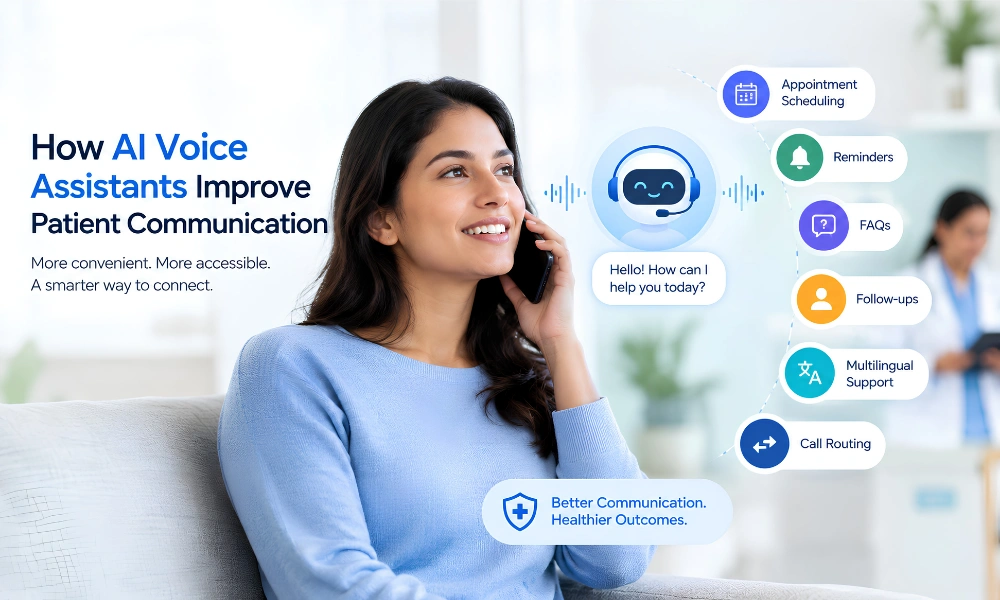
AI voice assistants improve patient communication by automating routine conversations such as appointment scheduling, reminders, frequently asked questions, patient follow-ups, basic information collection, and call routing.
They can provide support beyond traditional office hours and help healthcare teams manage repetitive communication. For complex, sensitive, or clinical situations, the AI should escalate the conversation to an appropriate healthcare professional.
Quick Answer: How Do AI Voice Assistants Improve Patient Communication?
AI voice assistants improve patient communication by automating routine conversations such as appointment scheduling, reminders, frequently asked questions, patient follow-ups, basic information collection, and call routing.
They can provide support beyond traditional office hours and help healthcare teams manage repetitive communication. For complex, sensitive, or clinical situations, the AI should escalate the conversation to an appropriate healthcare professional.
How Do AI Voice Assistants Improve Patient Communication?
AI voice assistants can improve patient communication in several ways, from making appointments easier to providing automated follow-ups and helping healthcare teams manage repetitive requests.
1. Provide 24/7 Patient Communication
Patients do not always need assistance during traditional business hours.
Someone may want to schedule an appointment in the evening, confirm a visit early in the morning, ask about clinic hours, or understand preparation instructions over the weekend.
An AI voice assistant can provide a communication channel outside normal office hours for approved, routine requests.
For example, a patient might call at 9:00 PM and say:
“I want to book an appointment for next week.”
Instead of reaching a voicemail system, the patient can interact with an AI assistant that can guide the conversation and, where integrated and authorized, access appointment availability.
This can make healthcare communication more convenient while allowing staff to focus on interactions that genuinely require human attention.
Important: 24/7 communication does not mean 24/7 clinical care. Healthcare AI systems should have clear boundaries and escalation paths for urgent or clinical situations.
2. Make Appointment Scheduling Easier
Appointment scheduling is one of the clearest applications for an AI voice assistant for healthcare.
Patients frequently call healthcare organizations to:
- Book appointments
- Reschedule appointments
- Cancel appointments
- Confirm appointments
- Ask about available times
- Find the right department
- Request follow-up appointments
Many of these interactions follow predictable workflows.
With appropriate integration, an AI voice assistant can understand the patient’s request and connect the conversation to a scheduling system.
For example:
Patient:
“I need an appointment with a dermatologist next week.”
AI assistant:
“I can help with that. What day would you prefer?”
The assistant can continue the conversation, identify available options, and either complete the permitted scheduling workflow or transfer the patient to staff.
This can reduce unnecessary phone queues and make appointment communication more convenient.
3. Reduce Missed Appointments With Automated Reminders
Appointment reminders are another practical use case for healthcare voice AI.
Healthcare organizations can use automated voice calls to remind patients about upcoming appointments and provide instructions about confirmation or rescheduling.
A reminder might follow this type of workflow:
Appointment scheduled
↓
Automated reminder generated
↓
AI voice call
↓
Patient confirms / reschedules / requests assistance
↓
System records the outcome
↓
Human escalation when necessary
Voice reminders can be particularly useful for patients who prefer phone communication over apps, portals, or email.
Rather than simply sending a one-way automated message, conversational AI can allow the patient to respond naturally.
4. Answer Routine Patient Questions
Healthcare organizations receive many repetitive questions every day.
Patients may ask:
- What are your clinic hours?
- Where is the clinic located?
- How do I reschedule my appointment?
- What should I bring to my appointment?
- How early should I arrive?
- How can I contact a specific department?
- What preparation is required for my appointment?
- What documents do I need?
An AI voice assistant can be connected to a carefully controlled healthcare knowledge base containing approved information.
This allows the organization to provide consistent responses instead of requiring staff to answer the same questions repeatedly.
For example:
“What time does the clinic open tomorrow?”
The assistant can provide the approved clinic-hours information without requiring a receptionist to handle the call.
For medical or high-risk questions, however, the workflow should be designed to escalate rather than allow the AI to make unsupported clinical claims.
5. Support Patient Follow-Up
Patient communication does not end when an appointment is completed.
Follow-up communication can involve reminders, instructions, surveys, scheduling, administrative questions, and requests for additional support.
AI voice assistants can help automate parts of this communication journey.
Before an appointment
- Appointment confirmation
- Reminder calls
- Preparation instructions
- Basic information collection
After an appointment
- Follow-up communication
- Reminder notifications
- Patient satisfaction surveys
- Scheduling assistance
- Administrative questions
- Escalation to staff
This creates a more connected patient communication journey instead of treating every phone call as an isolated interaction.
AI is already being explored and deployed in healthcare communication workflows. For example, the AMA recently highlighted an AI-driven outreach program used to deliver consistent telephone preparation, instruction, and reminder messages to patients, with the content based on a clinically approved knowledge base.
6. Personalize Patient Communication
Patients expect digital experiences to become more convenient and relevant to their individual needs.
A well-designed AI voice assistant can use authorized contextual information to personalize conversations.
Depending on the system and permissions, this may include:
- Appointment details
- Communication preferences
- Previous interaction context
- Preferred language
- Department or provider
- Scheduling information
- Approved patient information
For example, instead of asking a patient to repeatedly explain why they are calling, an integrated system may already understand that the conversation relates to an upcoming appointment.
However, personalization must be balanced with privacy, security, consent, and appropriate access controls.
Healthcare organizations should clearly define what information an AI assistant can access and what it is allowed to do with that information.
7. Support Multilingual Patient Communication
Language can become a barrier between patients and healthcare organizations.
AI voice technology can help organizations design multilingual communication experiences for patients who prefer languages other than the organization’s primary language.
Potential applications include:
- Appointment scheduling
- Appointment reminders
- General FAQs
- Administrative communication
- Follow-up calls
- Patient instructions
- Call routing
Multilingual voice interaction can make digital healthcare services more accessible, particularly when patients find text-based interfaces difficult to navigate.
However, organizations should carefully validate translations and establish escalation procedures for sensitive or clinically important communication.
8. Reduce Repetitive Work for Healthcare Staff
One of the biggest advantages of healthcare voice AI is not simply what it does for patients.
It is also what it can remove from the workload of healthcare staff.
Receptionists and administrative teams may spend significant time handling repetitive calls involving:
- Appointment changes
- Confirmations
- Clinic information
- Routine questions
- Follow-up requests
- Call routing
- Basic information collection
AI can handle appropriate portions of these workflows while staff remain available for more complicated requests.
Traditional workflow
Patient → Phone system → Waiting → Receptionist → Manual action
AI-assisted workflow
Patient → AI voice assistant → Understand request → Automated workflow → Completion or human escalation
This allows healthcare organizations to think of AI as a communication workforce multiplier, rather than simply another software interface.
9. Improve Patient Experience
Patient experience is strongly influenced by how easy it is to communicate with a healthcare organization.
A patient may be frustrated if they:
- Wait on hold for a long time
- Call repeatedly without reaching someone
- Cannot get help outside office hours
- Have to repeat the same information
- Struggle with complicated phone menus
- Receive inconsistent answers
AI voice assistants can address some of these friction points by providing conversational access to approved services.
Instead of remembering which number to press, patients can simply describe what they need.
The experience becomes:
“Tell us what you need.”
rather than:
“Press 1 for appointments. Press 2 for billing. Press 3 for…”
Traditional Patient Communication vs AI-Powered Communication
Healthcare organizations do not necessarily have to replace existing communication channels.
Instead, AI can become an additional layer within the existing patient communication infrastructure.
| Traditional Communication | AI-Assisted Communication |
|---|---|
| Limited by staff availability | Can provide routine support 24/7 |
| Manual appointment calls | Automated scheduling workflows |
| Long phone queues | Conversational self-service |
| Repetitive staff tasks | Automated routine requests |
| Manual reminders | Automated voice reminders |
| Repeated information collection | Structured automated workflows |
| Basic phone menus | Natural-language conversations |
| Manual routing | Intent-based routing |
| Human-only follow-ups | Automated follow-up workflows + escalation |
Who Can Benefit From AI Voice Assistants?
Hospitals
Hospitals can use voice AI to support high-volume administrative communication, appointment requests, reminders, information requests, and routing.
Medical Practices
Clinics can automate routine calls and reduce the administrative burden on reception teams.
Diagnostic Centers
Voice assistants can support appointment scheduling, preparation instructions, reminders, and follow-up communication.
Telehealth Providers
Telehealth organizations can use voice AI to support communication before and after virtual appointments.
Specialty Practices
Specialty providers can use controlled AI workflows for repetitive administrative communication while escalating complex patient requests.
Healthcare Call Centers
Call centers can use conversational AI to automate appropriate requests and route more complex interactions to the right department.
What Are the Business Benefits of AI Voice Assistants in Healthcare?
When properly implemented, AI voice assistants can provide benefits for both patients and healthcare organizations.
Faster communication
Patients can receive responses without always waiting for a staff member.
Reduced administrative workload
Staff can spend less time handling repetitive requests.
Scalable communication
An automated system can support a larger volume of routine interactions without requiring the same linear increase in staff capacity.
Consistent information
Approved knowledge sources can help standardize responses to common questions.
Better accessibility
Voice interfaces can provide an alternative to complex websites, portals, or text-based systems.
Improved patient experience
Patients can communicate using natural language instead of navigating complicated menus.
Better staff utilization
Healthcare teams can focus more attention on conversations that require human expertise.
See AI Voice Intelligence in Action
The potential of AI voice technology becomes clearer when it is applied to real-world communication workflows. Our AI Voice-Intelligence case study explores how intelligent voice technology can transform traditional conversations into automated, context-aware interactions.
From understanding natural language and responding conversationally to connecting voice interactions with business workflows, AI voice intelligence can help organizations create faster, more scalable communication experiences.
Explore the AI Voice-Intelligence case study to see how conversational voice technology can be designed around practical business requirements rather than simply replacing a traditional phone system.
The Future of AI Voice Assistants in Patient Communication
The future of healthcare voice AI is likely to move beyond basic phone automation.
Instead of simply answering calls, AI systems can become intelligent communication layers connected to multiple healthcare workflows.
A patient could potentially interact with one conversational interface that understands:
Who the patient needs to contact
Why they are calling
What appointment they are discussing
What information the organization has approved for the assistant to provide
Which workflow should happen next
When a human should take over
This creates a more connected patient communication experience.
However, greater capability also increases the importance of governance.
As AI becomes more embedded in healthcare workflows, organizations will need to pay closer attention to transparency, accountability, privacy, monitoring, and human oversight. AHRQ emphasizes that safe AI adoption requires shared responsibility among healthcare leaders, clinicians, and patients
Build a Custom AI Voice Assistant for Healthcare With BOSC Tech Labs
Every healthcare organization has different communication workflows, systems, patient populations, and operational requirements. A generic AI voice assistant may not be enough. AI voice assistants are most effective when they fit into the wider healthcare technology environment.
From patient communication and appointment workflows to integrations, data management, and administrative automation, organizations may need a broader technology foundation to support these capabilities.
Healthcare Software Development can help bring these connected workflows together into secure, scalable digital solutions designed around specific organizational requirements.
A custom solution can be designed around the organization’s existing patient journey and technology infrastructure.
At BOSC Tech Labs, healthcare organizations can explore AI-powered voice and conversational solutions designed around specific business workflows.
Potential capabilities include:
- Custom AI voice agent development
- Healthcare conversational AI
- Appointment scheduling automation
- AI-powered patient communication
- Automated reminder calls
- Patient follow-up workflows
- AI receptionist solutions
- EHR/EMR integrations
- CRM and API integrations
- Knowledge-base integrations
- Multilingual voice interactions
- Human escalation workflows
- Analytics and monitoring
- Secure AI architecture
The objective is not simply to add an AI voice to an existing phone system.
The objective is to build a reliable patient communication workflow where AI handles appropriate routine interactions and healthcare professionals remain in control of complex or clinical situations.
If your organization is exploring AI voice assistants for patient communication, BOSC Tech Labs can help evaluate the workflow, identify automation opportunities, design the conversational experience, and build the technology around your existing systems.
Explore how a custom AI voice assistant can improve your healthcare communication workflow with BOSC Tech Labs.
FAQ About AI Voice Assistants in Healthcare
AI voice assistants help healthcare organizations automate routine communication, improve response times, and reduce administrative workload.
What is an AI voice assistant in healthcare?
An AI voice assistant in healthcare is a conversational software system that allows patients to interact with a healthcare organization using spoken language. It can support approved workflows such as appointment scheduling, reminders, FAQs, follow-ups, information collection, and call routing while escalating complex or clinical situations to healthcare professionals.
How do AI voice assistants improve patient communication?
AI voice assistants can make patient communication faster and more accessible by providing conversational support for routine requests. They can help with appointment scheduling, reminders, FAQs, follow-ups, and administrative communication while reducing repetitive work for healthcare staff.
Can AI voice assistants schedule medical appointments?
Yes. When integrated with an appropriate scheduling system and given the necessary permissions, an AI voice assistant can support appointment booking, confirmation, cancellation, and rescheduling workflows.
Can AI voice assistants answer patient questions?
AI voice assistants can answer routine questions using approved organizational knowledge and defined workflows. Questions that are clinical, sensitive, outside the assistant’s knowledge, or otherwise high-risk should be routed to an appropriate healthcare professional.
Can AI voice assistants support multiple languages?
Yes. Voice AI can be designed to support multiple languages and language preferences. However, healthcare organizations should validate translations carefully, particularly for sensitive or clinically important communication.
What happens when an AI voice assistant cannot answer a patient?
A properly designed system should have an escalation workflow. The AI can transfer the conversation to an appropriate staff member, create a task, provide approved next steps, or route the patient to the correct department depending on the situation.
How much does a healthcare AI voice assistant cost?
The cost depends on factors such as conversation volume, AI model and voice infrastructure, integrations, security requirements, workflow complexity, languages, deployment architecture, and ongoing maintenance. A simple appointment assistant and an enterprise healthcare voice platform can have very different development requirements.
Conclusion
AI voice assistants are changing how healthcare organizations can communicate with patients.
From appointment scheduling and reminders to FAQs, follow-ups, patient intake, call routing, and multilingual communication, voice AI can automate many repetitive interactions and provide patients with a more convenient way to engage with healthcare organizations. But successful healthcare AI is not about replacing human communication.
It is about using AI where automation makes sense and keeping people involved where judgment, empathy, clinical expertise, and accountability matter most.
The strongest implementations combine conversational AI, secure integrations, approved knowledge, well-defined workflows, monitoring, and human escalation.
As healthcare organizations look for ways to improve patient experience while managing growing communication demands, AI voice assistants for patient communication can become an important part of the digital healthcare infrastructure.
BOSC Tech Labs can help organizations move from an AI concept to a custom voice-enabled workflow designed around their patients, systems, and operational requirements.