To build an AI POC, pick one business problem, agree a numeric success target, test a small slice of real data with the simplest method, and decide within 2 to 6 weeks whether to go ahead.
This guide is for CTOs, product heads and founders who want proof that an AI idea works before they fund a full build.
At BOSC Tech Labs, a typical POC runs 2 to 6 weeks, depending on how clearly the problem is defined and how clean the data is. This guide follows the same steps our team uses with clients.
The cost of skipping that proof is real. The 2025 MIT NANDA report, The GenAI Divide: State of AI in Business 2025, found that 95% of organizations in its research were getting zero return from generative AI.
A well-run POC shows early whether an idea deserves more money.It is the first stage of the full AI development process, which runs from idea to production.
Key takeaways
- An AI POC tests one business problem against one numeric target that is agreed before any build starts.
- Use real data, but only the smallest clean slice that can answer the question.
- Try the simplest approach first; a complex model rarely rescues data that has no signal.
- End with a clear call: move to an MVP, pivot the approach, or stop and keep the budget.
What is an AI POC?
An AI POC is a short, time-boxed test, typically 2 to 6 weeks, that shows whether AI can solve one business problem with your real data. It answers one question: can this work, with the data you have?
An AI proof of concept is not a demo built on sample data, and it is not a mini product. It has no polished interface, no integrations and no real users depending on it.
What it delivers is evidence: results measured against the target, an error analysis, known limitations and a recommendation on whether to build an MVP.
Some teams call this stage an AI feasibility test. The name matters less than the rule behind it: prove the idea on real data before you spend on a product.
AI POC vs MVP vs prototype: what is the difference?
A prototype shows what an AI feature could look like, a POC proves it can work with real data, and an MVP puts a working version in front of real users.
Take a support team that wants to predict which customers are about to complain. A prototype is a clickable screen with a risk score next to each customer, built in hours or days with no real data.
The POC takes 3 to 6 months of real complaint history and checks whether a model can flag future complainers better than the current approach. Its output is a performance snapshot, not a screen.
The MVP joins cleaned data from several sources and shows the risk score inside the support tool, where agents use it every day. That takes 6 to 16 weeks and a real commitment.
The table below sums up how the three stages differ.
| Criteria | Prototype | POC | MVP |
|---|---|---|---|
| Purpose | Show how the idea could look | Prove the idea works with real data | Deliver value to real users |
| Data used | None or sample data | 3–6 months of real data | Cleaned data from several sources |
| Key question | Does the concept make sense? | Can AI solve this with this data? | Will people use it and does it pay off? |
| Time | Hours to days | 2–6 weeks | 6–16 weeks |
| Output | Click-through demo | Performance snapshot | Working feature for real users |
| Commitment | Almost none | Medium | High |
The POC vs MVP line is the one teams blur most often: a POC answers whether it can work, while an MVP answers whether people will use it.
When should you start with a POC instead of a full product?
Start with a POC when the outcome is uncertain: new data, a new use case, or a technique your team has not used before. In those cases a small test costs far less than a failed build.
A POC pays for itself in four ways:
- It saves cost by stopping weak ideas before full development spending starts.
- It tests the assumptions behind the business case with real numbers.
- It exposes data gaps early, while they are still cheap to fix.
- It aligns stakeholders around evidence instead of opinions about what AI can do.
It also comes before an AI pilot project. A pilot runs a proven idea with real users in one team or site; a POC checks whether the idea works at all.
Skip the POC when a proven off-the-shelf tool already solves the problem, or when there is no data to test. In the first case run a short trial; in the second, start collecting data.
How to build an AI POC in 7 steps
To build an AI POC, define the problem, set numeric success criteria, audit a slice of data, choose the simplest approach, build a thin version, test it with users, then measure and decide.
Step 1: Write a one-sentence problem statement
Write the problem as one sentence that names the user, the decision and the outcome. If it takes a paragraph, the scope is still too wide for a POC.
A weak statement: “Use AI to improve customer service.” A strong one: “Flag customers likely to complain within 30 days so support agents can contact them first.”
Agree the sentence with the business owner before any data work starts. Every later choice in the POC is checked against it.
Step 2: Set numeric success criteria before you build
Agree on one numeric target before you build. Without a number set upfront, every result looks like progress and the final decision turns into a debate.
These proof of concept success criteria should match the business problem. For example, a complaint prediction POC may measure precision (how many flagged cases were correct) and recall (how many actual complaints the model identified). A document Q&A POC may measure answer accuracy and whether responses include the correct supporting sources.
Do not demand production-level accuracy. An AI POC shows whether the approach has enough potential to justify further investment. Set a realistic target that would support moving to an MVP, rather than expecting a finished product.
Step 3: Audit a small slice of real data
Check a small slice of real data before building anything. For the complaint example, 3 to 6 months of history from one source can show whether a signal exists.
Run through these questions:
- Is the data relevant to the exact problem statement?
- Are the key fields filled in consistently across records?
- Are outcomes labelled, for example which customers actually complained?
- Can the team access it quickly and with the right permissions?
- Does it reflect how the business works today?
Our clients often assume their data is ready, then find missing labels and inconsistent fields in the first week. We map what is reliable, start with the cleanest slice and log the gaps for the MVP.
Step 4: Choose the simplest approach that can answer the question
Start with the simplest method that could answer the question, such as a rule-based check or a basic model. If it finds no signal, a deep learning model rarely will.
Say a logistics team wants to predict delivery delays. A first test could use simple rules on distance, carrier and weather, then a basic model on the same fields.
If the basic model already beats today’s guesswork, the idea is feasible. A more complex model can come later, in the MVP, once the value is proven.
When we scope a POC, we try a simple model or a rule-based check first. If a basic approach finds no signal in the data, a complex model rarely fixes that, and the client saves weeks.
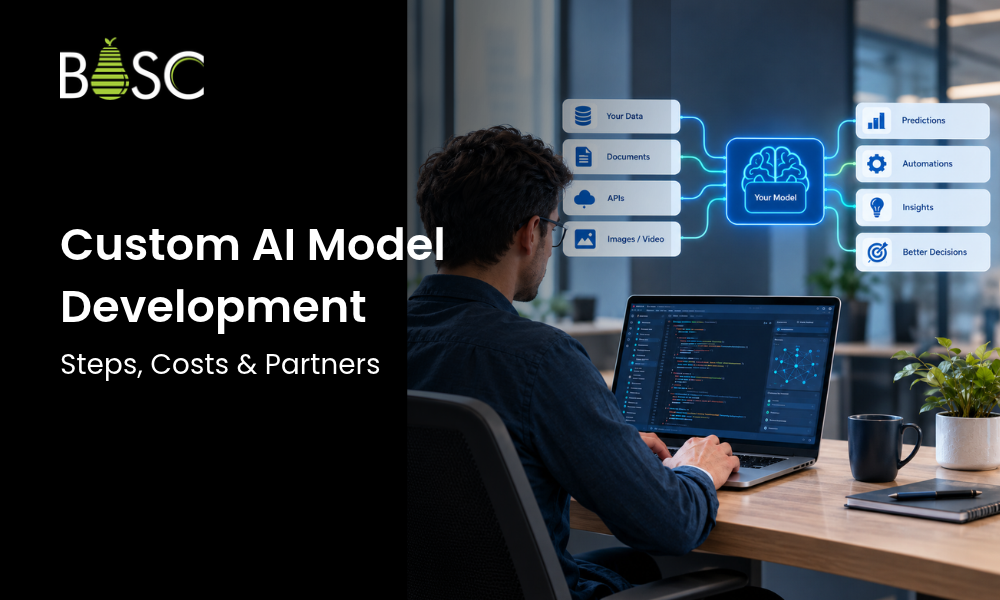
If the problem does call for a custom model, the guide to custom AI model development covers build options, costs and who to hire.
Step 5: Build a thin, throwaway version
Build only what the test needs: a data pipeline, the model and a simple output. The code exists to produce evidence, not to become the product.
For a warehouse stockout test, that could be a script that reads past stock levels and writes a daily list of at-risk items to a spreadsheet. No dashboard, no integrations.
Throwaway code is normal in AI POCs. Keep a short log of every shortcut you take; it becomes the list of what the MVP must build properly.
Step 6: Test it with the people who will use it
Put the output in front of one or two real users early. A model that scores well but does not fit their work will not survive an MVP.
In a manufacturing POC that predicts machine faults, ask the shift supervisor:
- Would this alert change what you do on this shift?
- How much warning do you need to act on it?
- Which false alarms would you ignore, and which would cost you?
- What would you need to see to trust the result?
Step 7: Measure the results and decide
Compare the results with the target from Step 2, not with a production system. The proof of concept success criteria decide the outcome, not how good the demo looks.
Suppose a retailer sets a target of identifying at least 70% of stockouts seven days in advance while keeping false alarms within an agreed limit. The results review then asks:
- How many real stockouts did the model flag a week ahead?
- How many alerts were false alarms, and in which stores?
- Where did it miss, and was the cause the data, the method or store processes?
- End with a short report: results against the target, an error analysis, known limitations and a recommendation to go ahead, pivot or stop.
POC timeline and budget: what to plan for
Most AI POCs take 2 to 6 weeks. Cost depends mainly on how much data preparation is needed, how complex the approach is and whether the test must connect to other systems.
An illustrative 4 to 6 week AI POC plan looks like this:
| Week | What happens | Output |
|---|---|---|
| Week 1 | Problem statement, success criteria, data access | Signed one-page brief |
| Week 2 | Data audit and baseline | Data gap list, baseline result |
| Weeks 3–4 | Build and test the simplest approach | First results against the target |
| Week 5 | User testing and error analysis | Error log, user feedback |
| Week 6 | Report and recommendation | Go, pivot or stop decision |
The budget for an AI POC is driven by three things:
- Data preparation: cleaning, labelling and access approvals often take longer than the modelling itself.
- Approach: a rule-based check or basic model costs less than fine-tuning or custom deep learning.
- Integrations: each live system the test must read from adds setup and security work.
- If you plan to bring in outside help for this, read the guide on choosing a RAG development partner.
What changes for generative AI and LLM POCs?
A generative AI POC still tests feasibility, but you measure answer quality on a fixed question set, hallucinations, latency and cost per request instead of one accuracy score.
Start by collecting a fixed set of real user questions, each with an approved answer and source. Run every version of the system against the same set so results stay comparable.
Measure four things:
- Answer quality: the share of answers that are correct and cite the right source.
- Hallucinations: answers that state facts not found in your documents.
- Latency: how long users wait for a complete answer.
- Cost per request: model and retrieval cost, multiplied by expected monthly volume.
Most document Q&A tests use RAG (retrieval-augmented generation), which fetches relevant passages before the model answers. An AI proof of concept here can show that retrieval, not the model, is the weak link.
Common POC challenges and how we solve them
Most problems in an AI POC come from four places: data that is not ready, expectations set too high, scope that keeps growing and teams with too little time to help.
Data is less ready than expected. Missing labels and inconsistent fields are normal, so work with the reliable slice and record every gap as input for the MVP plan.
Stakeholders expect production results. Agree upfront that a POC proves feasibility, and point back to the signed target whenever someone compares the test with a finished system.
The scope keeps growing. Every new idea goes on a list for the MVP, not into the current test, so the POC still ends on time with a clear answer.
The internal team has little time. The people who know the data and the process are also running the business, so their time must be planned in short, focused blocks.
Internal teams are usually running daily operations while supporting a POC. We work in short sprints with quick check-ins and simple outputs, so their input stays focused and the work keeps moving.
When to move from POC to MVP: the go/no-go decision
Move from an AI POC to an MVP when the results meet the agreed target, the business can see clear value and there is a visible path to improve the model further.
Before we recommend an MVP, we look for three signals: a repeatable direction in the results, value the business can clearly see, and a visible path to improve the model.
Use the matrix below to make the go/no-go decision from your results.
| Result | What it means | Next step |
|---|---|---|
| Meets target, users find it useful | Feasible and valuable | Plan the MVP |
| Close to target, clear path to improve | Promising | Extend 1–2 weeks or add data |
| Meets target, users do not act on it | Workflow mismatch | Redesign the output before an MVP |
| Misses target, no signal in the data | Not feasible with this data | Stop or rethink the problem |
A stop is not a failure if it comes early. It saves the budget a full build would have used and shows exactly why the idea did not work.
On a go, plan the path from POC to production before the MVP starts. Keep the architecture lightweight, but note what must change to handle real volume, security and monitoring.
Frequently asked questions
Can a failed AI POC still be useful?
Yes. A failed POC saves months of budget and shows exactly why the idea did not work: the data, the approach or the workflow. The only bad POC is one that pretends to work.
Who should be involved in an AI proof of concept?
Keep the group small: the business owner of the problem, one or two end users, someone who knows the data well, and the engineering team that builds and measures the test.
How much data do we need to start a POC?
Less than most teams expect. A relevant, consistent slice is enough to start, such as 3 to 6 months of history in the complaint example. Quality and clear labels matter more than volume.
What if our data is messy or incomplete?
That is normal, and finding it out is part of the purpose of a POC for AI. Work with the most reliable slice, measure what you can, and list what must be fixed before an MVP.
Should a POC include a user interface or dashboard?
Only if the decision depends on it. A spreadsheet, a CSV file or a simple daily list often proves the point faster, and the time saved goes into testing the model properly.
Should we build the POC in-house or with a partner?
It depends on your team’s AI experience. The 2025 MIT NANDA report found that externally partnered AI projects reached deployment about 67% of the time, compared with about one-third for internally built tools, based on its research sample.
Next step: pick one problem and test it with real data
An AI POC works when it is small, honest and measured: one problem, one numeric target, a slice of real data and a clear decision at the end. That is how you learn what to fund.
Write your one-sentence problem statement this week and check whether the data to test it exists. If you want help turning it into a 2 to 6 week test plan, talk to our AI consultants.