

Artificial intelligence has moved out of the innovation lab and into daily operations. It’s no longer something only large tech companies experiment with it’s showing up in how teams handle support tickets, forecast revenue, screen resumes, and decide what to build next.
AI in business is best understood not as a passing trend but as a strategic necessity. Companies that use it well are making faster decisions, cutting operational costs, and building better customer relationships, while those that ignore it risk falling behind competitors who move quicker and know more about their customers.
This article breaks down what AI in business actually means, why it matters right now, the concrete benefits it delivers, how it’s transforming different departments, and what a realistic path to adoption looks like challenges included.
What Is AI in Business?
In a business context, artificial intelligence refers to systems that can analyze data, recognize patterns, and make predictions or decisions with minimal human input. Rather than just following fixed instructions, AI systems learn from data and improve their outputs over time.
Practically, this means AI helps businesses:
- Analyze large volumes of structured and unstructured data
- Automate processes that used to require manual judgment
- Predict outcomes demand, churn, risk before they happen
Traditional automation vs AI-powered automation
Traditional automation follows rigid, rule-based logic. It’s reliable but inflexible. AI-powered automation, by contrast, can interpret unstructured inputs (like a customer email or an image), adapt to new patterns, and improve its accuracy as it processes more data.
Common examples of AI business solutions include chatbots and virtual assistants, recommendation engines, fraud detection systems, demand forecasting tools, and AI-driven workflow automation platforms that connect data across departments.
Why Is AI Important for Modern Businesses?
Several converging pressures are pushing AI from “nice to have” to “expected”:
- Increasing competition means decisions that used to take days now need to happen in hours.
- Growing volumes of business and customer data are difficult often impossible to interpret manually at scale.
- Operational efficiency and cost optimization have become priorities as margins tighten across most industries.
- Changing customer expectations mean people expect fast, personalized, always-available service.
- Competitive advantage increasingly comes from how well a company uses its own data, not just what it sells.
Businesses that build AI into their operations early are better positioned to respond to these pressures than those trying to catch up later.
Key Benefits of AI for Businesses
Automates Repetitive Tasks
AI takes over routine administrative and operational work data entry, invoice processing, scheduling, and basic customer queries. This reduces manual workload and frees employees to focus on higher-value activities that require judgment, creativity, or relationship-building.
Improves Business Efficiency
AI-powered tools streamline workflows by removing bottlenecks and reducing processing time. Tasks that once passed through multiple manual checkpoints can now move through automated pipelines, improving overall productivity across teams.
Enables Better Decision-Making
AI can analyze large datasets far faster than any human team, surfacing trends and patterns that would otherwise go unnoticed. This supports genuinely data-driven decisions instead of ones based on intuition or incomplete information.
Enhances Customer Experience
From AI-powered chatbots and virtual assistants to personalized product recommendations, AI helps businesses respond to customers faster and more relevantly. Response times shrink, and customers get answers that reflect their specific history and preferences.
Reduces Business Costs
By automating resource-intensive processes and reducing human error, AI helps businesses cut operational waste. It also improves resource allocation – routing budget, staff time, and inventory to where they’ll have the most impact.
Supports Business Growth
AI helps identify new opportunities by spotting patterns in market and customer data that inform sharper sales and marketing strategies. It also makes it easier to scale operations without proportionally scaling headcount.
How AI Is Transforming Different Business Functions
AI in Marketing
Marketing teams use AI for customer segmentation, personalized campaigns, and content or ad optimization. Predictive analytics help marketers anticipate what a customer is likely to want next, rather than reacting after the fact.
AI in Sales
In sales, AI supports lead scoring, revenue forecasting, and customer insight generation. Automated follow-ups keep prospects engaged without requiring a rep to manually track every touchpoint – tools like an AI sales engagement copilot can surface which leads are worth prioritizing.
AI in Customer Service
AI chatbots now handle a large share of customer service interactions, offering 24/7 support and automatically classifying and routing tickets. Sentiment analysis helps teams flag frustrated customers before a situation escalates a purpose-built AI customer support agent can manage much of this without adding headcount.
AI in Finance
Finance teams rely on AI for fraud detection, financial forecasting, automated invoice processing, and risk analysis reducing both errors and the time spent on manual reconciliation.
AI in Human Resources
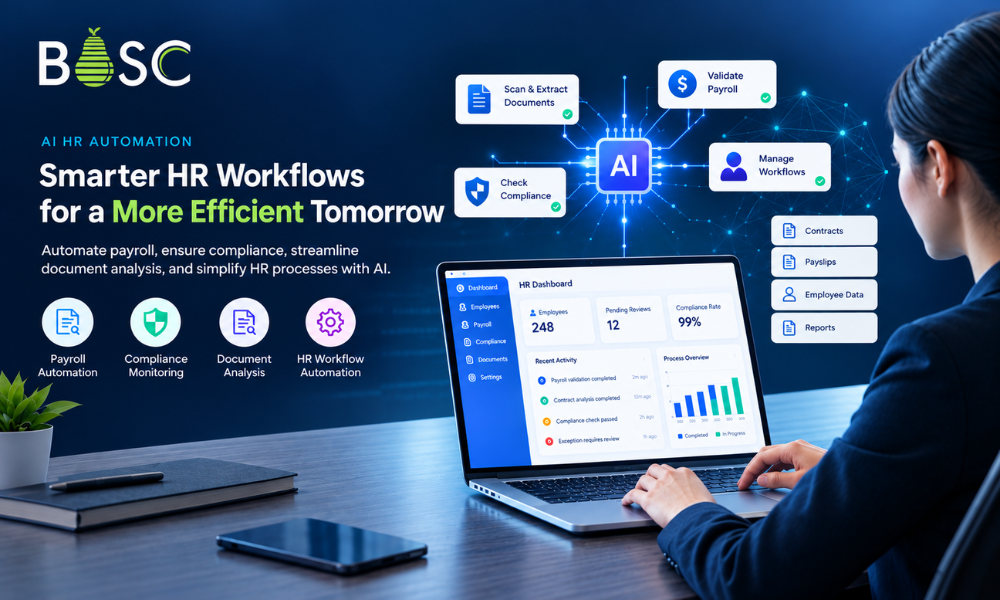
In HR, AI assists with resume screening, employee analytics, and recruitment automation, along with insights into what’s driving employee engagement or attrition.
Real-World AI Use Cases in Business
AI shows up across nearly every industry in practical, high-impact ways:
- Recommendation engines that personalize product or content suggestions
- Predictive maintenance that flags equipment issues before failure
- Demand forecasting that improves inventory and staffing decisions
- Intelligent document processing that extracts data from contracts and forms
- Fraud detection that flags anomalous transactions in real time
- Customer service automation that resolves routine queries instantly
- Personalized marketing that adapts messaging to individual behavior
- Supply chain optimization that improves routing and inventory turnover
The Impact of AI on Businesses
Companies that adopt AI thoughtfully tend to see measurable shifts: increased productivity, faster and smarter decision-making, and improved customer satisfaction. Operations become more scalable, since AI systems can handle growing volumes of work without a linear increase in cost.
AI also opens new business opportunities and revenue streams by surfacing insights that weren’t previously visible. At the same time, it’s changing the roles and skills organizations need fewer purely manual roles, more roles focused on managing, interpreting, and improving AI-driven systems.
Challenges of AI Adoption in Business
AI adoption isn’t without friction. Common challenges include:
- Initial implementation costs, which can be significant for custom systems
- Data privacy and security concerns, especially with sensitive customer data
- Integration with existing systems, which often weren’t designed with AI in mind
- Lack of AI skills and expertise in-house
- Accuracy and reliability concerns, particularly for high-stakes decisions
- Employee resistance to change, especially where AI affects existing workflows
- Ethical and responsible AI considerations, including bias and transparency
Recognizing these challenges early makes it far easier to plan around them rather than being blindsided later.
How Businesses Can Successfully Adopt AI
A structured approach reduces risk and improves the odds of a successful rollout:
- Identify specific business problems AI can realistically solve start with the pain point, not the technology.
- Start with high-value, manageable use cases rather than attempting an organization-wide overhaul at once.
- Ensure data quality and security before scaling any AI initiative.
- Select the right AI technology and tools for the specific problem, not just what’s trending.
- Train employees and build AI skills so teams can work effectively alongside new systems.
- Measure ROI and performance against clear, predefined metrics.
- Scale successful initiatives gradually, using early wins to build organizational confidence.
Many businesses find it useful to work with an experienced partner for this process AI consulting can help pinpoint where automation will create the most value before committing engineering resources.
The Future of AI in Business
AI adoption is accelerating across nearly every industry, driven largely by the growth of generative AI and increasingly capable AI agents. Businesses are moving toward greater automation of knowledge work not just repetitive manual tasks and toward more personalized customer experiences at scale.
Over the next few years, AI is likely to become less of a distinct “initiative” and more of a default part of everyday business operations. Understanding how to build an AI agent for a specific business process is becoming a practical starting point for companies planning that shift. What will separate the companies that benefit most is a clear, long-term AI strategy rather than reactive, one-off adoption.
Conclusion
AI has become a core driver of business performance, not a passing trend. The benefits efficiency, cost savings, better decision-making, stronger customer experience, and sustainable growth are consistent across industries and company sizes.
The businesses that get the most value from AI are the ones that adopt it strategically: starting with clear problems, building on data quality, and scaling deliberately rather than chasing every new tool. As AI capabilities continue to mature, it’s set to become one of the most important drivers of modern business success.
Frequently Asked Questions About AI in Business
Why is AI important for modern businesses?
AI helps businesses process growing volumes of data, respond to customers faster, and make decisions with more confidence all while facing rising competition and pressure to control costs.
What are the main benefits of AI for businesses?
Key benefits include automating repetitive tasks, improving efficiency, enabling better decision-making, enhancing customer experience, reducing costs, and supporting long-term growth.
How does AI improve business efficiency?
AI streamlines workflows by removing manual bottlenecks, reducing processing time, and handling high-volume tasks like data entry, scheduling, and query resolution automatically.
How can small businesses use AI?
Small businesses can start with accessible tools like AI chatbots, automated scheduling, and marketing personalization, focusing on high-value use cases before expanding further.
What are the challenges of AI adoption in business?
Common challenges include implementation costs, data privacy concerns, integration with legacy systems, a shortage of in-house AI skills, and employee resistance to change.
What is the future of AI in business?
The future includes wider adoption of generative AI and AI agents, greater automation of knowledge work, and AI becoming a standard, everyday part of business operations rather than a separate initiative.