


To hire React Native developers well, define the app scope, test real skills with a short practical task, compare rates by region and pick the hiring model that fits. This guide on how to hire react native developers covers each step.
It is written for founders, CTOs and product managers who need one app for iOS and Android and want to avoid a slow or costly hire.
BOSC Tech Labs builds cross-platform iOS and Android apps from our teams in Gandhinagar, Ahmedabad and Burbank, so this guide follows the questions clients ask us before they add a React Native engineer.
Below you will find the skills to test, typical rates, a six-step process, the main hiring models and the mistakes we see most often.
Key takeaways:
- Test the core react native developer skills with a short practical task, not a trivia quiz.
- A mid-level react native developer hourly rate runs from about $20 in India to $150 in the US.
- Follow six steps: scope, brief, sourcing, interview, checks and onboarding.
- Use freelancers for short tasks, a partner’s developer for an MVP and an in-house hire for a long-term core product.
What does a React Native developer do in 2027?
A React Native developer builds iOS and Android apps from one JavaScript or TypeScript codebase with Meta‘s open-source framework, then connects them to APIs, device features and the app stores.
React Native was first released in 2015. Since version 0.82, the New Architecture is its only architecture, which brings faster rendering and direct calls between JavaScript and native code.
Most new projects now start with Expo, a toolkit that handles builds, over-the-air updates and many device features, so a good developer should know it well.
On a typical week, a React Native developer will:
- Build screens and navigation that feel native on both iPhone and Android.
- Manage app state and load data from REST or GraphQL APIs.
- Add native features such as the camera, push notifications and in-app payments.
- Write tests, fix crashes and keep third-party libraries up to date.
- Prepare builds and releases for the App Store and Google Play.
A React Native developer is not the same as a web React developer. The ideas overlap, but if you need a website or web app, look at React JS developers for web apps instead.
When should you hire React Native developers instead of native or Flutter?
Choose React Native when you need one app on iOS and Android, your team already knows JavaScript or React, and the product is a business, commerce or content app. Choose native code for heavy graphics or hardware work.
Knowing how to hire react native developers starts with this decision, because the framework you pick sets the skills you test and the rates you pay.
The table compares the three common choices for a new mobile app.
| Factor | React Native | Native (Swift and Kotlin) | Flutter |
|---|---|---|---|
| Codebase | One for iOS and Android | Two, one per platform | One for iOS and Android |
| Main language | JavaScript | Swift for iOS, Kotlin for Android | Dart |
| Best for | Business, commerce and content apps; teams that know React | Heavy graphics, hardware access, platform-first features | Highly custom UI across platforms |
| Hiring pool | Large, shared with web React talent | Two separate pools | Growing, smaller than JavaScript |
For most business apps, both React Native and Flutter work well. The bigger factor is the talent you can hire and keep.
One shared codebase also lowers cost, because most features are built and maintained once. Our cross-platform mobile app development team checks this against your roadmap before any framework is chosen.
If your team already writes Dart or wants a highly custom interface, Flutter developers may be the better hire.
React Native developer skills to look for in 2027
The core react native developer skills are JavaScript and TypeScript, React hooks and state, native modules, performance tuning, testing and app store releases. Clear written updates matter too.
Strong candidates combine these technical skills with good habits: they write clear pull requests, raise problems early and explain trade-offs in plain words.
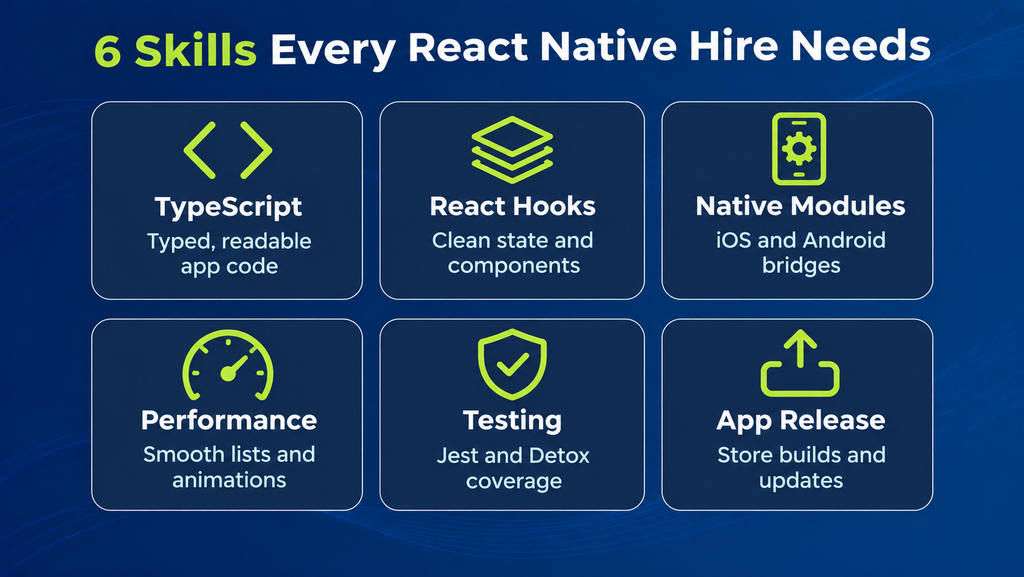
Use the table to match the level you hire to the work you need done.
| Skill area | Junior | Mid-level | Senior |
|---|---|---|---|
| JavaScript and types | Writes typed components | Types APIs and navigation | Sets project-wide types and lint rules |
| State and data | Follows existing patterns | Designs state for a feature | Chooses the app’s state approach |
| Native modules | Uses existing libraries | Configures permissions and native builds | Writes or adapts native modules |
| Performance | Fixes obviously slow screens | Profiles lists and re-renders | Sets performance budgets and monitoring |
| Testing | Writes simple unit tests | Covers screens with Jest | Sets up end-to-end tests with Detox |
| Releases | Runs local builds | Ships store builds | Owns CI and the release process |
For a first app, at least one mid-level or senior engineer should own the architecture.
When we screen engineers, we look past the tools listed on a résumé. We ask how they would structure state, handle a failed API call and test one screen, because those answers show real project work.
State decisions shape how easy the app is to change later. Our guide to state management in React explains the main options.
Soft skills matter just as much, especially in remote teams. Look for good time management on short deadlines, clear written updates and the habit of sharing knowledge and taking feedback well.
How to hire React Native developers in 6 steps
Define the scope, write a precise brief and source candidates. Then interview with a practical task, check references, make an offer and onboard with access and goals ready in week one.
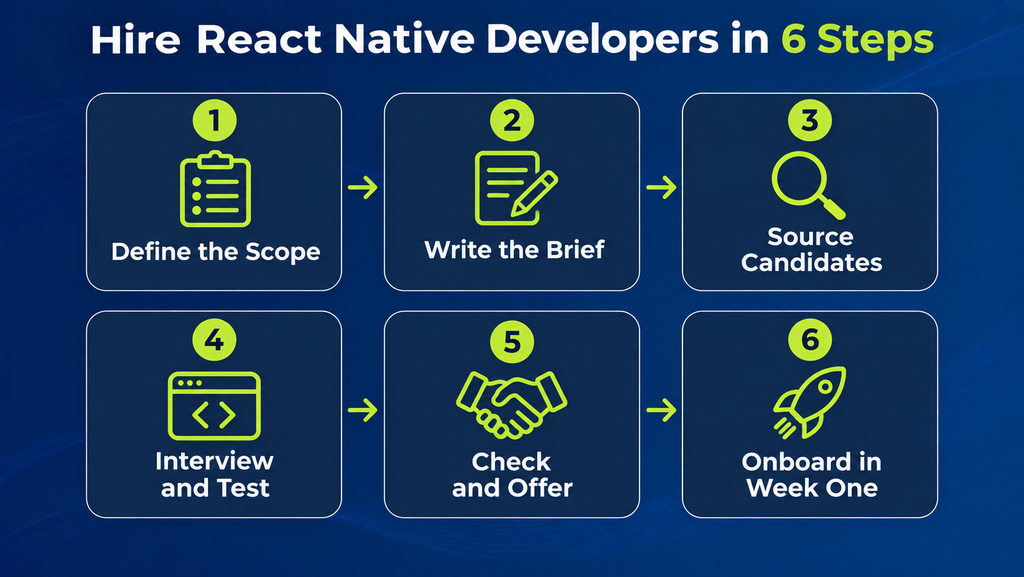
The six steps below show how to hire react native developers in a way that tests real work, not just interview polish.
- Define the scope. Decide whether you need a new app, new features or an upgrade, and whether the work is mobile only or also touches a web app.
- Write the brief. List the screens, integrations, release dates, time-zone overlap and seniority you need, so candidates can judge fit quickly.
- Source candidates. Use the channels described below and aim for five to eight serious profiles.
- Interview and test. Hold one technical conversation, then give a short practical task close to a real problem in your app.
- Check and offer. Speak to one or two past clients or managers, look at their apps in the stores, then agree on scope, rate and notice period.
- Onboard in week one. Give access to the code, designs, APIs and store accounts on day one, plus one small task to ship that week.
Good react native interview questions ask about real situations rather than definitions. Three that work well:
- How would you find out why a long list stutters on older Android phones?
- How do you share code between iOS and Android while handling platform differences?
- Tell me about a native module you wrote or changed, and what went wrong.
Keep the practical task to two to four hours and pay for anything longer. One small screen with data loading, error states and a test shows more than a whiteboard puzzle.
Every client interviews the engineer we propose before choosing them. The question we find most revealing is about a real production bug the candidate fixed, and how they tracked it down.
Where to find React Native developers
Each sourcing channel trades speed, cost and vetting differently:
- Freelance marketplaces such as Upwork and Toptal are fast, but you either do the vetting yourself or pay a premium for it.
- GitHub and the React Native community show real code, but searching them is slow and hard to scale.
- Referrals from your network bring high trust but usually only a few candidates.
- A development partner can share vetted profiles within days and replace someone who leaves.
How much does it cost to hire a React Native developer?
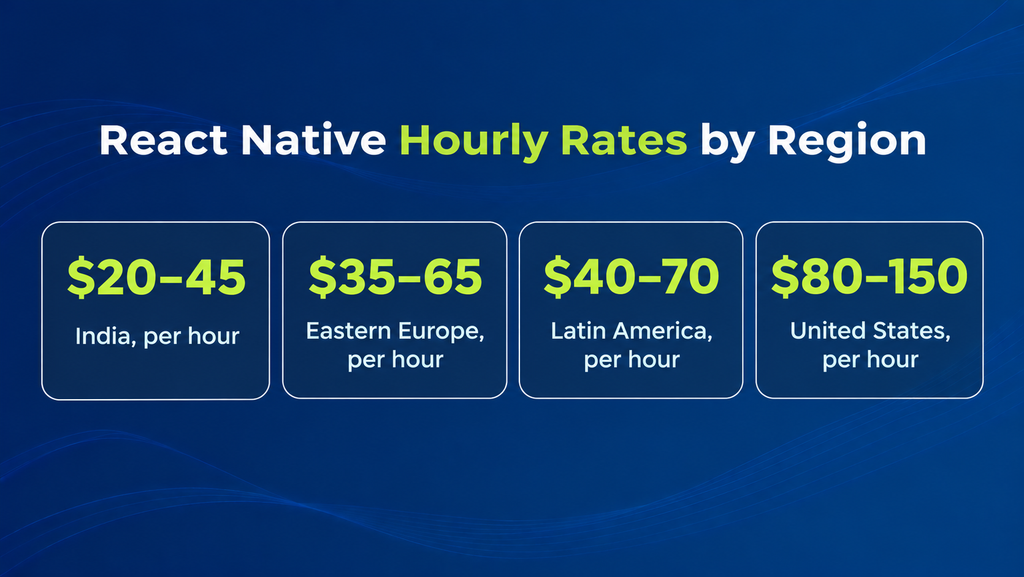
Most mid-level React Native developers cost about $20–45 an hour in India, $35–65 in Eastern Europe, $40–70 in Latin America and $80–150 in the US. Seniority, scope and hiring model move the final price.
Budget is the part of how to hire react native developers that many guides skip, so treat these ranges as a starting point, not a quote.
React Native developer hourly rate by region
A mid-level react native developer hourly rate depends mostly on where the developer lives and how you hire them. These are typical ranges as of late 2027.
| Region | Typical hourly rate (USD, mid-level) | What to know |
|---|---|---|
| India | $20–45 | Large talent pool; plan for time-zone overlap |
| Eastern Europe | $35–65 | Good overlap with European teams |
| Latin America | $40–70 | Good overlap with US teams |
| United States | $80–150 | Highest cost; same time zone for US teams |
A lower rate is not always a lower cost. A slower developer at $25 an hour can cost more than a faster one at $45 once rework and delays are counted.
Four factors move the price up or down:
- Seniority: senior engineers usually cost 30 to 50% more than mid-level ones.
- Native work: custom native modules, Bluetooth or video features need rarer skills.
- Time-zone overlap: more shared working hours with your team often cost more.
- Contract length: longer engagements usually get better monthly rates.
In-house hires also carry hidden costs on top of salary: recruiting time, benefits, equipment and the weeks a role stays empty.
Freelance, in-house or dedicated: which hiring model fits?
Freelancers suit short, well-defined tasks. In-house hires suit a core product you will own for years. A dedicated developer from a partner suits teams that need speed, continuity and backup without a long hiring cycle.
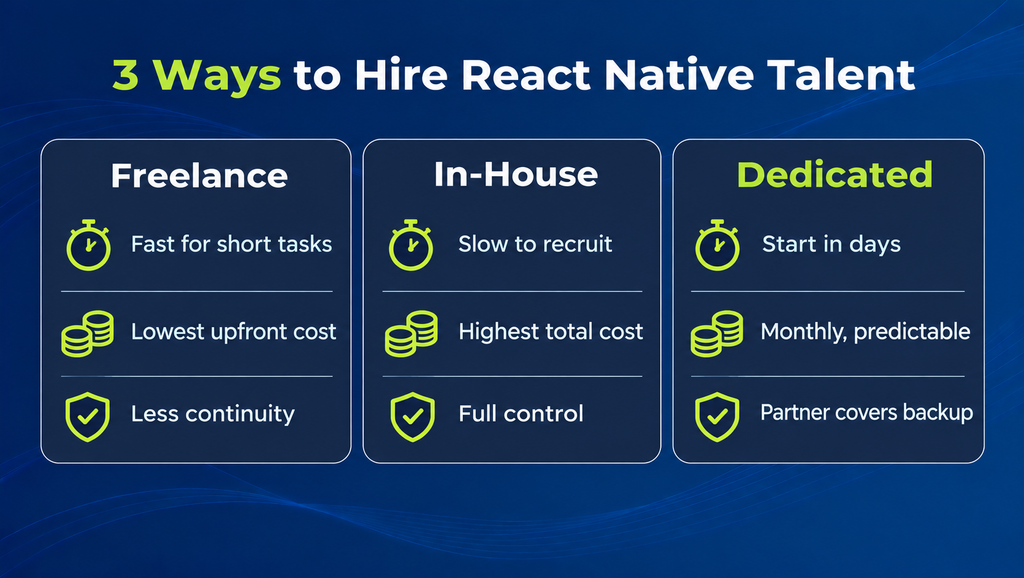
The model shapes every later step in how to hire react native developers: who vets candidates, who manages them and who covers gaps.
| Model | Time to start | Cost pattern | Best for | Main risk |
|---|---|---|---|---|
| Freelance | Days | Hourly, lowest upfront | Short, defined tasks | Less continuity |
| In-house | Often 4–8 weeks | Salary plus benefits and recruiting | A core product you will own for years | Slow to hire |
| Dedicated through a partner | About 1–2 weeks | Monthly and predictable | MVPs and growing products | Depends on the partner’s vetting |
We usually share matched profiles within 48 to 72 hours, and most engagements start within 7 to 10 business days, so you can test fit with one engineer before you scale the team.
Dedicated React Native developers through a partner
Dedicated react native developers work full time on your product but stay employed by the partner, which handles payroll, equipment and replacements.
Our staff augmentation services follow this model: you interview and pick the engineer, set the priorities and run the work inside your own team.
If you would rather hand over the whole build, a react native development company can deliver it as a fixed-scope project with its own project manager and QA.
How to hire React Native developers without costly mistakes
The costly mistakes are hiring a web React developer for native work, skipping the practical task and choosing on hourly rate alone. Starting before store, analytics and backend access is ready is another.
In apps we inherit, a common blocker is old libraries that stop upgrades. We check package versions and New Architecture support first, before anyone estimates new features.
Watch for these red flags during interviews:
- The candidate cannot explain a bug they fixed or how they found it.
- They have no shipped apps you can download from the App Store or Google Play.
- They avoid questions about testing or say tests slow them down.
- They are vague about recent framework changes and library upgrades.
- They agree to every deadline without asking about scope.
One more mistake is hiring a single developer for a product that also needs design, backend and QA work. Decide who covers those roles before the first sprint starts.
Frequently asked questions
Is React Native still worth it in 2027?
Yes, for most business apps. Meta still maintains React Native, the New Architecture is now its only architecture, and one codebase covers iOS and Android. Choose native code for heavy graphics or hardware work.
How long does it take to hire a React Native developer?
In-house hiring often takes 4 to 8 weeks from job post to start date. Freelance platforms and development partners can usually share suitable profiles within days, and a partner’s developer can often start within two weeks.
Can a React JS developer build React Native apps?
Partly. React ideas such as components, hooks and state carry over, but mobile work adds native modules, device testing, permissions and store releases. Expect a ramp-up, or pair them with an experienced mobile engineer.
Should I hire a junior or senior React Native developer for an MVP?
Start with a senior or strong mid-level engineer, because architecture choices made in the first weeks are expensive to undo. Juniors can join once the structure is in place and a senior reviews their code.
Do React Native developers need to know Swift or Kotlin?
Not for everyday screens, but mid-level and senior engineers should read and adjust native iOS and Android code. They need it for permissions, build settings, native modules and platform-specific crashes.
What should a React Native take-home test include?
One small screen that loads data from an API, shows loading and error states and includes at least one automated test. Keep it to two to four hours, review it together on a call and pay for longer tasks.
Hire for real project experience, not résumé keywords
The best React Native hire is the person who can show shipped apps and solve a problem close to yours, not the one with the longest list of tools.
Now you know how to hire react native developers: set the scope, test with a short practical task and compare rates by region. Then choose the model that fits how long you need the person.
If you want vetted engineers who can join your team quickly, talk to BOSC Tech Labs about your app and the profile you need.